
Innovation
Forbes Center welcomes Harrisonburg, Rockingham fifth-graders for live arts – Augusta Free Press
Neque porro quisquam est, qui dolorem ipsum quia dolor sit amet, consectetur, adipisci velit, sed quia non numquam eius.


More than 450 fifth-grade students in Harrisonburg City Public Schools and Rockingham County Public Schools will get to see master storyteller Charlotte Blake Alston and jazz violinist Diane Monroe in Fiddlin’ with Stories thanks to the Forbes Center for the Performing Arts’ partnership with Any Given Child Shenandoah Valley.
The Forbes Center is the premier performance partner of Any Given Child Shenandoah Valley, a 501(c)(3) organization focused on ensuring equitable access in the arts for all children in grades K-8 in Harrisonburg.
Students will have the opportunity to attend a matinee on April 19. The 80-minute performance will be followed by a question-and-answer session with Alston and Monroe. Alston wrote the program with her late brother, jazz violinist John Blake, Jr. The show focuses on how ancient and modern stringed instruments have played an integral role in the African and African American communities through folktales, stories and songs.
The Forbes Center is actively involved in educational outreach and has committed to offering varying groups and age ranges within K-8 the chance to experience at least two live performances and one dance workshop per season, according to Regan Byrne, executive director of the Forbes Center and a member of the Board of Directors for Any Given Child Shenandoah Valley. When Byrne booked an evening performance of Fiddlin’ with Stories for the 2021–2022 Forbes Center Masterpiece Season, she also booked the school matinee. Byrne says she makes “a conscious decision to book ‘Forbes Family Fun’ shows that align with the HCPS and RCPS educational goals.”
Now in their ninth season, Forbes Family Fun shows were introduced by the Center to provide quality performing arts programming for young audiences and their families. This year’s Forbes Family Fun series is sponsored by Shenandoah Valley Airport and has included a free school matinee to Catapult, the world’s premier shadow dance company, for 450 HCPS sixth and seventh graders. Charlotte Blake Alston and Diane Monroe in Fiddlin’ with Stories is also tapped as a Forbes Family Fun show—which includes a ticketed performance on Tuesday, April 19 at 6:30 p.m.
Byrne worked with the guest artists as well as J.R. Snow, director of Any Given Child Shenandoah Valley, to determine the appropriate age range for the Fiddlin’ with Stories school matinee. “We are excited to welcome fifth graders to this performance. It is the first time some of these students have had the opportunity to experience live arts in a professional theatre setting.”
This year’s partnership with Any Given Child Shenandoah Valley has also included two dance workshops at the Forbes Center. These interactive dance experiences introduced over 900 RCPS third graders to various forms of movement and dance terminology.
In addition, the School of Music hosted over 1000 fourth graders in HCPS and RCPS in February in the 1100-seat Wilson Hall as part of its Orchestra Discovery Concert series. The Conductor’s Spellbook program featured the JMU Symphony Orchestra with narration by Foster Beyers, JMU director of orchestras.
Forbes Center student matinees and Orchestra Discovery Concerts have reached over 7,500 students since 2019.
Tickets to Charlotte Blake Alston and Diane Monroe in Fiddlin’ with Stories are $34–35 with a $15 child’s ticket. For tickets, visit www.jmuforbescenter.com or call the Forbes Center Box Office at (540) 568-7000. For more information on Any Given Child Shenandoah Valley,
Enter your email address to subscribe to this blog and receive notifications of new posts by email.
Augusta Free Press launched in 2002. The site serves as a portal into life in the Shenandoah Valley and Central Virginia – in a region encompassing Augusta County, Albemarle County, Nelson County and Rockingham County and the cities of Charlottesville, Harrisonburg, Staunton and Waynesboro, at the entrance to the Blue Ridge Parkway, Skyline Drive, Shenandoah National Park and the Appalachian Trail.









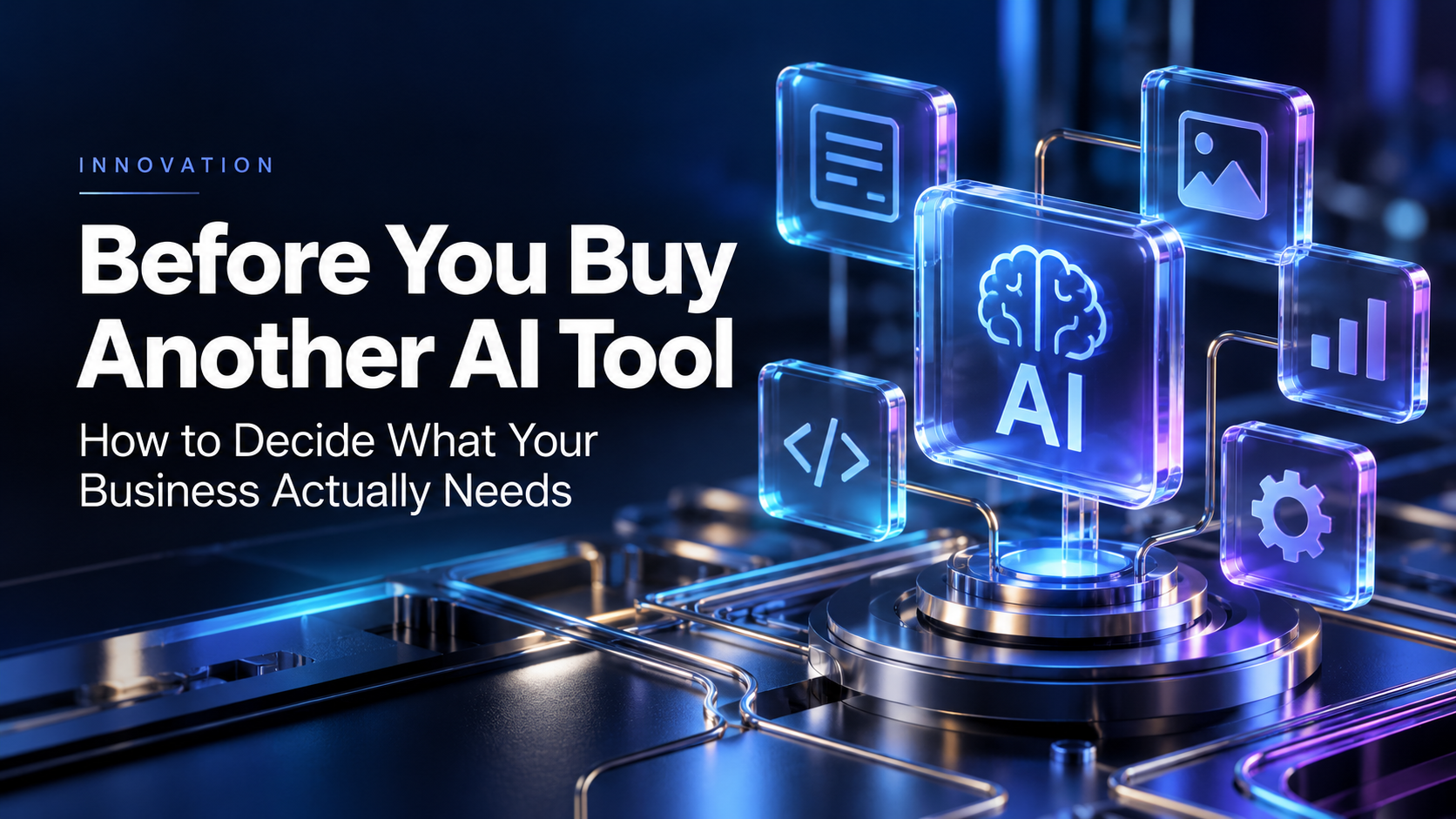
An entrepreneur watches a demonstration of a new AI tool, sees it complete a task in seconds, and signs up. A month later, the subscription is still active, but the tool has barely been used. The demonstration solved an interesting problem. It may not have solved that business owner’s problem.
Before adding another subscription, start with the work your business needs to improve. A useful purchase should have a clear purpose, an owner, and a way to measure whether it helps.
Start with a specific task
“We need to use AI” is too broad to guide a purchase. “We spend three hours each week turning meeting notes into client updates” gives you something to evaluate. Write down the task, how often it happens, who performs it, and what a good result looks like. If the task itself is unclear, document the process before choosing a tool.
Check what you already own
Review the software your team currently uses. An existing platform may already include a feature that handles the task. Ask whether the new product replaces something, improves an existing process, or creates another place to manage information. A useful feature can still be an unnecessary purchase if it duplicates a service you already pay for.
Test the entire workflow
A fast first draft does not always mean a faster finished result. During a trial, count the time spent entering information, checking the output, correcting mistakes, and moving the work into its final destination. Test ordinary tasks and difficult ones. For customer-facing work, include human review before anything is sent or published.
Decide what information belongs in the tool
Read the provider’s terms and data controls before entering customer records, confidential documents, or sensitive business information. Ask who can access the information, how long it is retained, and whether it is used to improve the service. If those answers do not fit your responsibilities to clients, choose a different workflow.
Set a clear purchase standard
For a simple example, imagine a tool costs $50 a month and reduces a recurring task from four hours to one. That could be useful if the remaining review is manageable and the saved time supports valuable work. But if the team spends three extra hours fixing the output, the benefit disappears. Set your own threshold before the trial begins.
Assign one person to review the results before the renewal date. Keep the tool if it produces a clear improvement at an acceptable cost. Cancel it if it does not. Buying technology becomes easier when every subscription must earn its place in the business.

The first wave of generative AI taught millions of people how to talk to machines.
The next wave is teaching machines how to act.
Across the technology industry in 2026, companies are moving beyond simple AI assistants toward systems commonly known as AI agents. Instead of waiting for a person to provide instructions for every individual task, these systems can pursue goals, interact with software, retrieve information, coordinate steps, and complete parts of business processes.
It represents a fundamental shift in the evolution of artificial intelligence.
The question is no longer simply, “What can AI tell me?”
Increasingly, the question is, “What can AI do for me?”
From Answers to Actions
Traditional chatbots are largely reactive.
A user asks a question, the system generates an answer, and the interaction ends.
AI agents are designed differently.
Imagine asking an AI system to identify potential customers, research their businesses, organize the information, update a CRM, prepare personalized outreach, and flag the highest-priority opportunities.
Instead of helping with only one step, an agent could potentially coordinate several steps across multiple applications.
Google Cloud describes this transition as a move from one-off AI tasks toward systems capable of orchestrating complete workflows. Its 2026 research, based on thousands of executives, identifies agent-based systems as a major business transformation trend.
IBM similarly describes deployed AI agents as systems that can interact with company software, databases, and business tools while carrying out tasks for real users.
This is why agentic AI is attracting so much attention.
It transforms AI from a productivity accessory into part of a company’s operating infrastructure.
Businesses Are Moving Beyond Experiments
For the past several years, many companies experimented with AI through small pilot programs.
An employee might use AI to summarize documents. A marketing department might use it to brainstorm copy. Developers might use it to assist with coding.
Those applications remain useful, but the ambition is growing.
Organizations are now experimenting with AI systems that operate across customer service, finance, cybersecurity, software development, supply chains, research, and internal operations.
Google Cloud has been running 2026 programs specifically focused on moving organizations from basic chatbots toward production-ready, multi-agent workflows.
The innovation is not necessarily a single smarter model.
It is the ability to connect intelligence with tools, data, memory, business rules, and actions.
That combination could be far more disruptive than the chatbot revolution that introduced generative AI to the mainstream.
Automation Is Also Moving Into the Physical World
The same shift from assistance to action is appearing outside office software.
Transportation provides a striking example.
Automation and artificial intelligence are increasingly being used in trucking, shipping, rail systems, and other transportation infrastructure. Recent developments include autonomous trucking operations, AI-assisted navigation, and automated monitoring systems designed to reduce downtime and improve efficiency.
This suggests that the larger innovation story is not simply about AI-generated text or images.
It is about increasingly intelligent systems becoming participants in real economic activity.
Software agents can move information.
Autonomous machines can move physical goods.
When those two developments continue advancing together, entirely new operating models become possible.
The Biggest Challenge May Be Trust
Autonomy creates opportunity, but it also creates risk.
Giving an AI system permission to answer a question is very different from giving it permission to modify a database, approve an action, communicate with a customer, access source code, or interact with sensitive corporate information.
Security therefore becomes central to the agentic AI revolution.
In August 2026, Reuters reported growing enterprise demand for technology designed to secure AI agents, particularly as those agents gain access to sensitive company data and business systems.
Companies adopting autonomous AI will need strong permission controls, monitoring, identity management, audit trails, and clear rules determining when humans must remain involved.
The winning systems may not necessarily be the most autonomous.
They may be the systems organizations trust enough to use at scale.
Humans Are Still Part of the System
Predictions about AI frequently frame the future as humans versus machines.
The real future may be much more collaborative.
AI agents are particularly powerful when they handle repetitive coordination while humans remain responsible for goals, judgment, relationships, creativity, exceptions, and accountability.
A salesperson might supervise several prospecting agents.
A developer might manage coding agents.
A financial analyst could use agents to continuously collect and organize information before reviewing the conclusions.
A customer-service professional might focus on complicated cases while automated systems resolve routine issues.
This creates an interesting possibility: employees may eventually manage digital workers in much the same way managers coordinate human teams today.
Innovation Is Moving From Tools to Systems
The most important technological transitions often become obvious only after the technology disappears into everyday life.
The internet stopped being a destination and became infrastructure.
Cloud computing moved from an emerging technology to a standard way of operating businesses.
Smartphones turned dozens of individual technologies into one everyday platform.
AI may now be beginning a similar transition.
The first stage gave people intelligent tools.
The next stage may give businesses intelligent systems capable of executing work.
There will be failures, security challenges, regulatory questions, and unrealistic expectations along the way. Not every process should become autonomous, and not every AI experiment will produce meaningful returns.
But the direction is becoming increasingly clear.
Artificial intelligence is moving beyond conversation.
It is beginning to participate in the work itself.
And that could make the rise of AI agents one of the most consequential innovation stories of 2026.
The next phase of artificial intelligence is not about getting better answers. It is about software that can take action, complete workflows and increasingly operate alongside human teams.
For the past several years, artificial intelligence has largely been experienced through a chat box. A user asks a question, the system generates an answer, and a person decides what happens next.
In 2026, that model is beginning to change.
The technology industry is moving rapidly toward AI agents—systems designed not merely to provide information but to perform tasks, interact with software, make decisions within defined limits and complete multi-step workflows.
Gartner has projected that as many as 40% of enterprise applications could include task-specific AI agents by the end of 2026, compared with less than 5% in 2025. That represents a fundamental shift in how businesses may interact with software.
From Answers to Actions
The difference between an AI assistant and an AI agent may sound technical, but its business implications are straightforward.
An assistant might draft an email telling a customer that an appointment is available.
An agent could potentially check the calendar, schedule the appointment, update the customer record, send the confirmation and trigger the appropriate follow-up.
That difference—between recommending an action and executing an action—is becoming one of the most important developments in enterprise technology.
Meta, for example, introduced a Business Agent in June 2026 designed to handle activities such as answering customer questions, qualifying leads, booking appointments and potentially processing transactions. The company said more than one million businesses were already using earlier versions of its business chatbots across WhatsApp and Messenger.
Similar competition across the technology industry suggests that agentic AI is becoming less of a laboratory experiment and more of a commercial product category.
Small Businesses Could Be Major Beneficiaries
Large corporations have obvious reasons to invest in automation, but AI agents could have an even more noticeable impact on smaller companies.
A large enterprise can employ separate teams for customer support, marketing, administration, research and operations. A small company often expects the same person—or the founder—to handle several of those responsibilities.
AI could begin narrowing that operational gap.
The OECD’s 2026 D4SME survey, which examined more than 2,000 small and medium-sized businesses across 12 OECD countries, found that SME adoption of AI is rising rapidly. Most currently rely on off-the-shelf tools, while some have started experimenting with more customized applications and AI agents.
That creates the possibility of a new kind of small company: one where a relatively small human workforce coordinates a much larger digital operating layer.
A five-person business may still have five employees, but those employees could eventually have AI systems handling research, scheduling, routine customer questions, document preparation, data entry and portions of sales administration.
The Real Challenge Is Trust
The excitement surrounding AI agents also introduces a much harder question.
How much authority should software receive?
Allowing an AI system to draft a response is relatively low risk. Allowing it to issue refunds, change customer records, approve purchases or communicate independently with clients requires far stronger controls.
Meta itself has acknowledged the risks that emerge when AI agents are connected deeply to business systems and given permission to act.
The companies that succeed with agentic AI therefore may not be those that automate the largest number of tasks first. They may be those that build the clearest boundaries around what machines can do independently, what requires approval and what must remain entirely human-controlled.
Security, data governance, audit trails and human oversight are becoming just as important as model intelligence.
The OECD has similarly found that although AI adoption among SMEs is growing, secure and strategic integration remains uneven, with skills shortages, implementation costs and limited time among the barriers facing smaller firms.
The Competitive Advantage Will Come From Redesigning Work
There is another reason the AI-agent shift matters.
Simply inserting an AI tool into an old process may produce incremental efficiency. Redesigning the process around what humans and machines each do best could produce something much larger.
Imagine a sales team where an AI system continuously organizes leads, researches prospects and prepares account summaries while humans focus on relationship building and negotiation.
Or a logistics company where agents watch inventory, flag unusual movements, prepare recommendations and coordinate routine actions while managers concentrate on exceptions and strategic decisions.
The technology becomes more valuable when businesses stop asking, “Which employee task can AI copy?” and start asking, “How would we design this operation if intelligent software had always existed?”
2026 May Be Remembered as the Transition Year
Generative AI first attracted mass attention because machines could produce surprisingly human-like text and images.
The next stage may attract attention for a different reason: machines will increasingly be judged by what they accomplish, not simply by what they generate.
Gartner expects the evolution to continue beyond individual task agents toward groups of specialized agents collaborating across applications and business functions.
That future is not guaranteed to arrive smoothly. Technical failures, cybersecurity threats, regulatory questions and organizational resistance will continue to shape adoption.
But the direction is becoming clearer.
The defining question of the AI era is changing from “What can AI tell me?” to “What can AI responsibly do for me?”
For businesses, entrepreneurs and technology leaders, that may prove to be the far more consequential question.
-

 Leadership2 years ago
20 Entrepreneurs to Watch Closeout 2024
-

 Real Estate2 years ago
Startups Are Looking To Fractionalize Real Estate Assets, But Should They? – Forbes
-

 Innovation3 years ago
Leo Horacio: A Successful Entrepreneur in the Ecommerce and Online Sales Industry
-

 Innovation2 years ago
Innovators in Social-Emotional Learning: Dr. Myava Clark and Chris Clark Jr.
-

 Music2 years ago
Artist Deydee Signs $350,000 Contract with Rueda Empire LLC
-

 Latest2 years ago
Florida Gov DeSantis signs 15-week abortion ban | Latest News
-

 Money2 years ago
Trailblazer in Business: Alicia Fitts on Building Wealth and Community Through Faith
-

 Latest2 years ago
Charles zhang recognized by forbes as #1 on michigan’s 2022 best in state wealth advisor list