
Small Business
Small Business Confidence Is Rising Again—But Growth Comes With a New Set of Challenges


After months of economic uncertainty, there are signs that America’s small-business economy is regaining some momentum. Entrepreneurs are starting companies at a faster pace, existing business owners are becoming more optimistic, and more employers are preparing to hire.
But this is not a return to easy growth.
The small-business environment of 2026 is increasingly defined by a different challenge: owners may see opportunities to expand, but finding the right employees, managing financing costs, protecting margins and making smart investments are becoming critical to turning optimism into sustainable growth.
Confidence Is Returning to Main Street
The latest numbers offer an encouraging picture.
The National Federation of Independent Business reported that its Small Business Optimism Index increased 2.4 points to 99.8 in July 2026, putting it above its long-term average of 98 and at its highest level since August 2025. Eight of the index’s ten components improved during the month.
Perhaps more important is what business owners intend to do next.
A seasonally adjusted net 20% of small-business owners said they planned to create jobs during the next three months, the strongest hiring intention recorded since October 2022. Meanwhile, 25% planned capital expenditures during the next six months, the highest level since December 2024.
That combination suggests small-business owners are not simply feeling more confident. Many are beginning to think about expansion again.
And new entrepreneurs continue to enter the market.
The U.S. Census Bureau reported 578,926 business applications in July 2026, seasonally adjusted, an 8.1% increase from June. The agency projected nearly 30,000 new employer businesses would emerge within four quarters from July’s applications.
Entrepreneurial activity, in other words, remains alive and well.
The Biggest Problem Is Shifting
For much of the past several years, inflation dominated business conversations. Rising materials, transportation, energy and operating expenses forced many small companies to increase prices or accept thinner margins.
Those pressures have not disappeared, but the latest data suggest the concern is changing.
In July, 14% of surveyed small-business owners identified inflation as their most important business problem, down seven percentage points from June. At the same time, 27% identified labor quality or availability as their biggest problem, making workforce issues the leading concern.
Thirty-six percent reported job openings they could not fill, the highest percentage since June 2025. Among businesses hiring or attempting to hire, a large majority reported receiving few or no qualified applicants.
That creates an unusual situation.
Businesses increasingly want to hire at the same time that many cannot find the people they need.
For small companies, this problem can be particularly serious. Large corporations may have dedicated recruiters, larger salary budgets and stronger employer brands. A business with 10 or 20 employees often does not have those advantages.
The result is that the next stage of small-business competition may be fought as much over talent as customers.
Small Businesses Need to Rethink Hiring
Throwing another job listing online may no longer be enough.
Owners looking to expand should increasingly think about the employee experience in much the same way they think about the customer experience.
Competitive pay matters, but so do scheduling flexibility, career development, workplace culture, training and clear opportunities for advancement.
Small businesses can also compete in ways that larger companies sometimes cannot.
They can give employees greater responsibility earlier. They can make decisions faster. Employees may have more direct access to leadership and a clearer understanding of how their work affects the company.
Those advantages need to become part of the recruiting message.
Businesses should also reconsider whether every position requires an experienced candidate. When qualified talent is scarce, hiring capable people and developing them internally can sometimes be more effective than waiting months for a perfect résumé.
Growth Still Needs Financial Discipline
Improving confidence should not be confused with inexpensive money.
NFIB’s July survey found that the average interest rate owners reported paying on short-maturity loans was 7.9%. Meanwhile, Federal Reserve lending data showed that credit standards remained toward the tighter end of their historical range across many lending categories, even as conditions for commercial and industrial lending were relatively more accommodating.
That means expansion decisions need to be deliberate.
Buying equipment, opening another location or adding employees may create growth, but only when the expected return justifies the cost.
Owners should know three numbers before committing to major expansion: the additional monthly cost, the realistic revenue the investment can generate, and how long the business can comfortably carry the expense if sales develop more slowly than expected.
In an uncertain economy, cash reserves and flexibility can be just as valuable as rapid growth.
Protecting Margins Matters More Than Chasing Revenue
Revenue growth looks impressive, but profitability keeps businesses alive.
Small-business owners should therefore pay close attention to which products, customers and services actually produce their strongest margins.
Some businesses may discover that a relatively small group of customers generates most of their profit. Others may find that an apparently popular product consumes too much labor, inventory or delivery expense to remain worthwhile.
The strongest companies will use this period of improving confidence to become more selective—not simply bigger.
That could mean eliminating low-margin offerings, renegotiating supplier contracts, introducing minimum order requirements, adjusting pricing or focusing sales efforts on the customers most likely to become profitable long-term relationships.
The Opportunity Is Real, but So Is the Uncertainty
The current numbers are encouraging, but business owners are hardly carefree.
NFIB’s Uncertainty Index increased to 91 in July, remaining well above its historical average. Sales expectations also softened slightly even as overall confidence improved.
That combination captures the current small-business environment remarkably well.
Owners are optimistic enough to invest.
They are cautious enough to know conditions can change.
That may actually be a healthy combination.
The businesses positioned to perform best in the next phase are unlikely to be those that expand at any cost. They will be companies that grow selectively, recruit creatively, control expenses, preserve cash and remain close enough to their customers to recognize changes in demand early.
A New Phase for Small Business
Small-business optimism returning above its long-term average is meaningful. Rising business applications are meaningful too.
They show that entrepreneurs continue to believe there are opportunities worth pursuing despite a complicated economic environment.
But 2026 is also demonstrating that optimism alone does not build a successful company.
Execution does.
For entrepreneurs, the opportunity now is to turn improving confidence into stronger businesses without repeating the mistakes that often accompany rapid expansion.
The next winners in small business may not be the companies that grow the fastest. They may be the ones that learn how to grow without losing control.

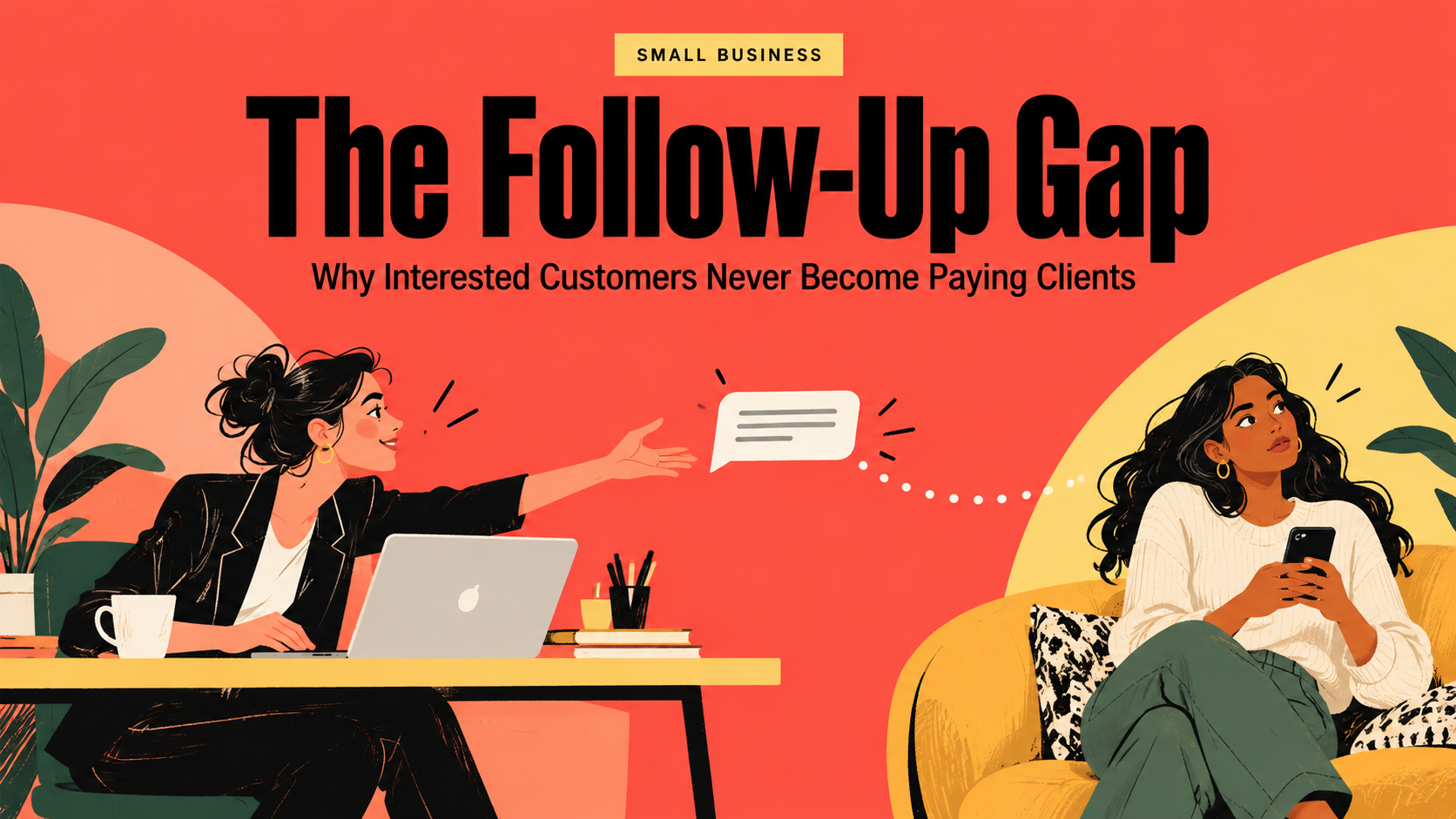
A potential customer asks for pricing. The owner sends a proposal, receives no reply, and moves on. Two weeks later, neither person has taken another step. The business cannot tell whether the prospect lost interest, became busy, or still has an unanswered question.
Follow-up helps resolve that uncertainty. It gives an interested person a clear path toward a decision while helping the business understand which opportunities are still active.
Make the next step clear
A conversation can feel productive without producing a commitment. Before it ends, agree on what happens next. Will the prospect review a proposal, book a call, or confirm a start date? Ask when a follow-up would be helpful. “May I check back on Thursday after you have reviewed the details?” is easier to act on than “Let me know.”
Keep a record of the actual conversation
Record what the person asked for, the problem they want to solve, their timing, and any concerns they raised. A spreadsheet or customer relationship management system can help. The important part is keeping a reliable record with a next action and a responsible team member. Avoid collecting personal details that are unnecessary for serving the prospect.
Give each message a purpose
A useful follow-up adds context or removes an obstacle. If someone asked about scheduling, send the available dates. If they questioned fit, explain who the service is designed to help and where its limits are. A relevant example may help them evaluate the offer, provided you have permission to share it and represent the result accurately.
For example: “Hello Jordan, you mentioned wanting to start next month. I have included the two scheduling options we discussed. Would either work for your team, or has your timeline changed?” The message is specific and leaves room for an honest answer.
Use a reasonable follow-up rhythm
Build the timing around the buyer’s decision process and any agreement you made. An urgent service request and a large annual purchase may require different approaches. Avoid treating every unanswered message as permission to contact someone daily. Honor requests to stop, and make it easy for people to decline.
Know when to close the conversation
An opportunity should not stay open forever simply because no one said no. Send a brief closing message when appropriate: “I will close this inquiry for now. If the timing changes, you are welcome to reach out.” That creates a clear stopping point without pressure.
Review where conversations stall. If prospects repeatedly ask the same question, improve the proposal or sales conversation. If replies go unanswered internally, fix ownership and response handling. Better follow-up begins with making the buying process easier to understand.
Featured
The 2026 Small Business Opportunity: How Entrepreneurs Can Turn Economic Change and AI Into Growth


Running a small business in 2026 requires entrepreneurs to pay attention to two economies at the same time.
There is the traditional economy of prices, employees, interest rates and consumer spending.
Then there is the rapidly developing digital economy being shaped by artificial intelligence.
For entrepreneurs willing to understand both, the current environment may create opportunities to operate smarter, control costs and compete with companies much larger than their own.
There Are Signs of Relief—but Business Owners Should Remain Cautious
New economic data released August 13 showed that U.S. producer prices were unchanged in July after declining slightly in June. Goods prices fell 0.7%, while the cost of services increased 0.2%. Producer prices were still 4.7% higher than a year earlier, meaning inflation has not disappeared.
For business owners, that creates a mixed picture.
Certain expenses may begin to stabilize, but entrepreneurs should not assume that everything is going back to pre-inflation pricing.
This is the time to understand the numbers inside the business.
Owners should know their customer acquisition cost, profit margins, operating expenses and the amount of revenue generated by each major product or service.
When the economy is uncertain, cash-flow visibility becomes even more important.
Productivity Is Becoming the New Growth Strategy
One encouraging development has been productivity.
U.S. nonfarm productivity increased at a 1.4% annualized rate during the second quarter of 2026 and was 2.2% higher than a year earlier. Economists and policymakers are watching whether continued AI investment will help increase productivity further.
For the small-business owner, productivity means something very practical:
How can you produce more value without simply working more hours?
The traditional entrepreneurial response to growth is often to hire more people, work longer hours or spend more money.
Technology offers another option.
Businesses can increasingly automate repetitive work while allowing owners and employees to spend more time on activities directly connected to revenue and customer relationships.
Small Businesses Are Using AI—but Many Have Barely Scratched the Surface
There is a noticeable difference between using AI and actually building AI into a business.
Goldman Sachs reported in March that 76% of small businesses participating in its survey were using AI, with 93% of users reporting a positive impact. However, only 14% said AI had been fully integrated into their core operations.
Broader Census Bureau data paints an even more cautious picture. From December 2025 through May 2026, overall business AI usage measured by its Business Trends and Outlook Survey remained around 17% to 20%, with adoption generally higher among larger companies. Less than 20% of businesses with four or fewer employees reported using AI.
The surveys measure AI use differently, but together they highlight an important opportunity.
Most entrepreneurs are still figuring this out.
That means the competitive advantage has not disappeared.
Start With the Work You Do Every Week
Small businesses do not need complicated AI strategies to begin.
Start by looking at tasks repeated every week.
For example:
- Following up with potential customers
- Answering frequently asked questions
- Creating social media content
- Writing email campaigns
- Preparing proposals
- Organizing meeting notes
- Researching potential clients
- Creating basic reports
- Scheduling appointments
- Reviewing customer feedback
Then ask:
Which of these activities can technology make faster without lowering the quality of the customer experience?
Saving 30 minutes once is useful.
Saving 30 minutes on a task performed every day can change the economics of a business.
Do Not Use AI Simply to Produce More Content
One of the easiest traps for entrepreneurs is using AI only to create more posts, emails and articles.
That is useful, but it is only the beginning.
A more important question is how technology can help the company produce more revenue.
Could AI help identify better prospects?
Could it shorten response times?
Could it improve customer follow-up?
Could it analyze why customers are leaving?
Could it help employees serve twice as many customers?
Those questions move AI from a content tool to a business-growth tool.
Protect the Human Advantage
Small companies possess something many large corporations spend millions trying to recreate:
personal connection.
Customers can often speak directly with the owner.
Employees know customers by name.
Decisions can be made quickly.
The business can adapt without going through several management levels.
Entrepreneurs should be careful not to automate away that advantage.
Use technology to eliminate unnecessary work so that people have more time for relationships, not less.
Think in 90-Day Business Cycles
This environment rewards entrepreneurs who move quickly.
Instead of creating a giant three-year technology plan, business owners can select one measurable goal for the next 90 days.
Increase leads.
Improve customer retention.
Reduce administrative time.
Increase sales conversions.
Improve profit margins.
Then identify two or three tools or processes that could help reach that specific goal.
Test them.
Measure the results.
Keep what works.
Remove what does not.
Then begin another 90-day cycle.
Small Businesses Can Still Move Faster Than Big Businesses
Large corporations may have more employees, larger budgets and massive technology departments.
Small businesses have another advantage.
They can move.
An entrepreneur can identify a problem Monday, test a solution Wednesday and change the entire process by Friday.
That ability to move quickly becomes extremely valuable when technology and economic conditions are changing this fast.
The small businesses that grow over the next several years will not necessarily be the ones spending the most money.
They will be the ones paying attention, protecting their cash, embracing useful technology and making better decisions faster than their competitors.
In 2026, being small does not have to be a disadvantage.
When combined with technology, focus and speed, it may become one of a company’s greatest advantages.

In 2026, small businesses are navigating a rapidly changing financial landscape, where traditional methods of funding are no longer the only game in town. With economic shifts, technological advancements, and new consumer behaviors, the funding options available to entrepreneurs have exploded in both variety and complexity. The days of relying solely on bank loans or personal savings are fading. Instead, small businesses now have access to a diverse suite of funding channels—each offering its own unique set of opportunities and challenges.
Whether you’re an ambitious startup looking to scale or a seasoned entrepreneur eyeing your next big project, understanding the full spectrum of funding options is crucial. This isn’t just about survival; it’s about seizing the right financial lifeline to propel your business into the future.
Traditional Bank Loans
Traditional bank loans have long been the backbone of small business financing. For decades, they have offered reliable and stable support for entrepreneurs looking to grow. In 2026, these loans still hold strong appeal due to their:
- Low interest rates – Making it an affordable option for long-term financial needs.
- Predictable repayment terms – Helping businesses manage cash flow with stability.
However, the game has changed. While the appeal remains, these loans come with certain challenges:
- Stringent lending requirements – Banks are more cautious about who qualifies for loans, especially with the current economic climate.
- Lengthy approval process – Getting approval can take weeks, slowing down critical growth opportunities.
- Fluctuating interest rates – Economic instability can lead to unpredictable costs.
In short, while still a viable option for some, traditional bank loans are no longer the go-to choice for many small businesses in 2026.
Government Grants and Subsidies
Government grants and subsidies continue to be an attractive option for businesses in 2026, particularly those in emerging sectors. These programs, often designed to encourage innovation or support public good, offer several benefits:
- No repayment required – Grants are essentially “free” money, which can provide much-needed relief to small businesses.
- Targeted support – Specific programs are available for green energy, technology innovation, and other key industries.
However, securing government grants isn’t without its downsides:
- Competitive application process – Many businesses vie for a limited pool of funds, making it difficult to win.
- Limited availability – Funding is typically restricted to particular sectors, meaning many businesses won’t qualify.
Despite the challenges, government programs remain a strong funding option for businesses that fit within the criteria.
Venture Capital and Angel Investors
Venture capital (VC) and angel investors have always been synonymous with high growth potential. For businesses aiming for rapid expansion, these sources of funding offer significant advantages:
- High growth potential – VCs and angel investors are looking for businesses with a strong chance of scaling quickly.
- Expertise and mentorship – Investors often provide guidance and industry connections that can accelerate growth.
However, these advantages come at a cost:
- Equity dilution – Entrepreneurs often give up significant control in exchange for funding, which can impact future decision-making.
- High expectations for rapid growth – VCs and angels expect quick returns, putting pressure on businesses to perform.
For those willing to navigate the challenges, VC and angel funding can be a lucrative path for ambitious small businesses.
Crowdfunding
Crowdfunding has proven to be a powerful tool for small businesses, particularly those in niche markets or creative industries. Platforms like Kickstarter, Indiegogo, and GoFundMe offer businesses the chance to:
- Access a large pool of small investors – Crowdfunding opens up the opportunity to raise capital from a wide range of backers.
- Generate buzz and marketing exposure – Public campaigns can create momentum and excitement around your business or product.
However, the visibility crowdfunding provides can have some significant risks:
- Public exposure of ideas – Competitors can easily spot new ideas, potentially stealing them.
- Risk of not reaching funding goals – If a campaign doesn’t hit its target, the business gets nothing, which can waste time and resources.
Despite these risks, crowdfunding remains an attractive funding option for businesses that can harness its potential for community-driven success.
Alternative Financing
Fintech has revolutionized the way small businesses access capital. In 2026, alternative financing options such as peer-to-peer lending, invoice financing, and revenue-based financing are gaining popularity due to their:
- Faster access to funds – Unlike traditional bank loans, fintech options can provide quick capital, often in a matter of days.
- Flexible terms – Many fintech platforms offer customized financing options tailored to business needs, with fewer restrictions.
However, there are some drawbacks to consider:
- Higher fees – Faster access to capital often comes with higher costs, including interest and service fees.
- Risk of over-leveraging – Small businesses may find themselves in debt if they don’t manage borrowed funds responsibly.
These alternative financing methods can provide quick solutions, but it’s crucial for business owners to carefully weigh the costs and risks before diving in.
Making the Right Choice: Aligning Funding with Your Business Strategy
As the options for funding multiply, small businesses in 2026 face an exciting but complex decision-making process. The right financial support hinges on your unique business needs, goals, and stage of growth. Whether you’re looking to secure long-term stability through a traditional bank loan, attract investors for fast growth, or leverage fintech for quick, flexible capital, understanding each funding method’s strengths and limitations is essential. By strategically selecting the right funding source, you can set your business up for sustainable success and navigate the future with confidence.
-

 Leadership2 years ago
20 Entrepreneurs to Watch Closeout 2024
-

 Real Estate2 years ago
Startups Are Looking To Fractionalize Real Estate Assets, But Should They? – Forbes
-

 Innovation3 years ago
Leo Horacio: A Successful Entrepreneur in the Ecommerce and Online Sales Industry
-

 Innovation2 years ago
Innovators in Social-Emotional Learning: Dr. Myava Clark and Chris Clark Jr.
-

 Music2 years ago
Artist Deydee Signs $350,000 Contract with Rueda Empire LLC
-

 Latest2 years ago
Florida Gov DeSantis signs 15-week abortion ban | Latest News
-

 Money2 years ago
Trailblazer in Business: Alicia Fitts on Building Wealth and Community Through Faith
-

 Latest2 years ago
Charles zhang recognized by forbes as #1 on michigan’s 2022 best in state wealth advisor list