Innovation
Leo Horacio: A Successful Entrepreneur in the Ecommerce and Online Sales Industry
Neque porro quisquam est, qui dolorem ipsum quia dolor sit amet, consectetur, adipisci velit, sed quia non numquam eius.


Leo Horacio is a name that resonates in the world of entrepreneurship and ecommerce.
His journey is a testament to determination and success, and his story inspires many.
As an immigrant who arrived in the United States at the age of 11 after losing his father in a tragic car accident, Leo faced significant challenges from a young age. However, his entrepreneurial spirit led him to create his first business at the astonishing age of 17. Surprisingly, before turning 22, he had already reached his first million dollars. With over 10 years of experience in the ecommerce and online sales industry, Leo Horacio has founded and led four multi-million-dollar companies in the United States.
One of his most notable achievements has been the establishment of a company dedicated to managing ecommerce brands, which generated $10 million in its first 12 months and contributed to $125 million in sales for its clients. Furthermore, he has assisted over 450 investors in earning automated monthly incomes of $6,000 to $8,000 through his team.
But Leo has not only excelled in the business world. He has also shown his social commitment by donating to local foundations that rescue abandoned dogs and provide toys for needy children.
Leo’s motivation for entering the ecommerce industry is clear: it is a trillion-dollar industry that continues to grow, and more Latin American countries are adapting to online sales. This means that opportunities continue to expand every day.
His achievements have earned him recognition and awards, including plaques for taking eight stores to reach $1 million in less than 12 months. Additionally, in 2023, he will receive an award for reaching the astounding figure of $25 million in sales in a single year.
Leo’s personal experience as an immigrant in the United States, where he had to leave school to work and support his family after losing his father, has been a fundamental influence on his journey.
Leo’s impact in his field and in society is undeniable. He has been invited to major conferences where he has inspired hundreds of thousands of Latin American entrepreneurs with his story and impressive results.
Looking to the future, in 2024, Leo plans to expand his foundation to build homes for needy families in low-resource countries and continue growing his personal brand to share his story and expertise with a wider audience.
You can follow Leo Horacio on his social media platforms, where he shares his vision and knowledge in the world of ecommerce and entrepreneurship. His story is a testament to the power of entrepreneurship and determination to overcome challenges and achieve success.










The first wave of generative AI taught millions of people how to talk to machines.
The next wave is teaching machines how to act.
Across the technology industry in 2026, companies are moving beyond simple AI assistants toward systems commonly known as AI agents. Instead of waiting for a person to provide instructions for every individual task, these systems can pursue goals, interact with software, retrieve information, coordinate steps, and complete parts of business processes.
It represents a fundamental shift in the evolution of artificial intelligence.
The question is no longer simply, “What can AI tell me?”
Increasingly, the question is, “What can AI do for me?”
From Answers to Actions
Traditional chatbots are largely reactive.
A user asks a question, the system generates an answer, and the interaction ends.
AI agents are designed differently.
Imagine asking an AI system to identify potential customers, research their businesses, organize the information, update a CRM, prepare personalized outreach, and flag the highest-priority opportunities.
Instead of helping with only one step, an agent could potentially coordinate several steps across multiple applications.
Google Cloud describes this transition as a move from one-off AI tasks toward systems capable of orchestrating complete workflows. Its 2026 research, based on thousands of executives, identifies agent-based systems as a major business transformation trend.
IBM similarly describes deployed AI agents as systems that can interact with company software, databases, and business tools while carrying out tasks for real users.
This is why agentic AI is attracting so much attention.
It transforms AI from a productivity accessory into part of a company’s operating infrastructure.
Businesses Are Moving Beyond Experiments
For the past several years, many companies experimented with AI through small pilot programs.
An employee might use AI to summarize documents. A marketing department might use it to brainstorm copy. Developers might use it to assist with coding.
Those applications remain useful, but the ambition is growing.
Organizations are now experimenting with AI systems that operate across customer service, finance, cybersecurity, software development, supply chains, research, and internal operations.
Google Cloud has been running 2026 programs specifically focused on moving organizations from basic chatbots toward production-ready, multi-agent workflows.
The innovation is not necessarily a single smarter model.
It is the ability to connect intelligence with tools, data, memory, business rules, and actions.
That combination could be far more disruptive than the chatbot revolution that introduced generative AI to the mainstream.
Automation Is Also Moving Into the Physical World
The same shift from assistance to action is appearing outside office software.
Transportation provides a striking example.
Automation and artificial intelligence are increasingly being used in trucking, shipping, rail systems, and other transportation infrastructure. Recent developments include autonomous trucking operations, AI-assisted navigation, and automated monitoring systems designed to reduce downtime and improve efficiency.
This suggests that the larger innovation story is not simply about AI-generated text or images.
It is about increasingly intelligent systems becoming participants in real economic activity.
Software agents can move information.
Autonomous machines can move physical goods.
When those two developments continue advancing together, entirely new operating models become possible.
The Biggest Challenge May Be Trust
Autonomy creates opportunity, but it also creates risk.
Giving an AI system permission to answer a question is very different from giving it permission to modify a database, approve an action, communicate with a customer, access source code, or interact with sensitive corporate information.
Security therefore becomes central to the agentic AI revolution.
In August 2026, Reuters reported growing enterprise demand for technology designed to secure AI agents, particularly as those agents gain access to sensitive company data and business systems.
Companies adopting autonomous AI will need strong permission controls, monitoring, identity management, audit trails, and clear rules determining when humans must remain involved.
The winning systems may not necessarily be the most autonomous.
They may be the systems organizations trust enough to use at scale.
Humans Are Still Part of the System
Predictions about AI frequently frame the future as humans versus machines.
The real future may be much more collaborative.
AI agents are particularly powerful when they handle repetitive coordination while humans remain responsible for goals, judgment, relationships, creativity, exceptions, and accountability.
A salesperson might supervise several prospecting agents.
A developer might manage coding agents.
A financial analyst could use agents to continuously collect and organize information before reviewing the conclusions.
A customer-service professional might focus on complicated cases while automated systems resolve routine issues.
This creates an interesting possibility: employees may eventually manage digital workers in much the same way managers coordinate human teams today.
Innovation Is Moving From Tools to Systems
The most important technological transitions often become obvious only after the technology disappears into everyday life.
The internet stopped being a destination and became infrastructure.
Cloud computing moved from an emerging technology to a standard way of operating businesses.
Smartphones turned dozens of individual technologies into one everyday platform.
AI may now be beginning a similar transition.
The first stage gave people intelligent tools.
The next stage may give businesses intelligent systems capable of executing work.
There will be failures, security challenges, regulatory questions, and unrealistic expectations along the way. Not every process should become autonomous, and not every AI experiment will produce meaningful returns.
But the direction is becoming increasingly clear.
Artificial intelligence is moving beyond conversation.
It is beginning to participate in the work itself.
And that could make the rise of AI agents one of the most consequential innovation stories of 2026.
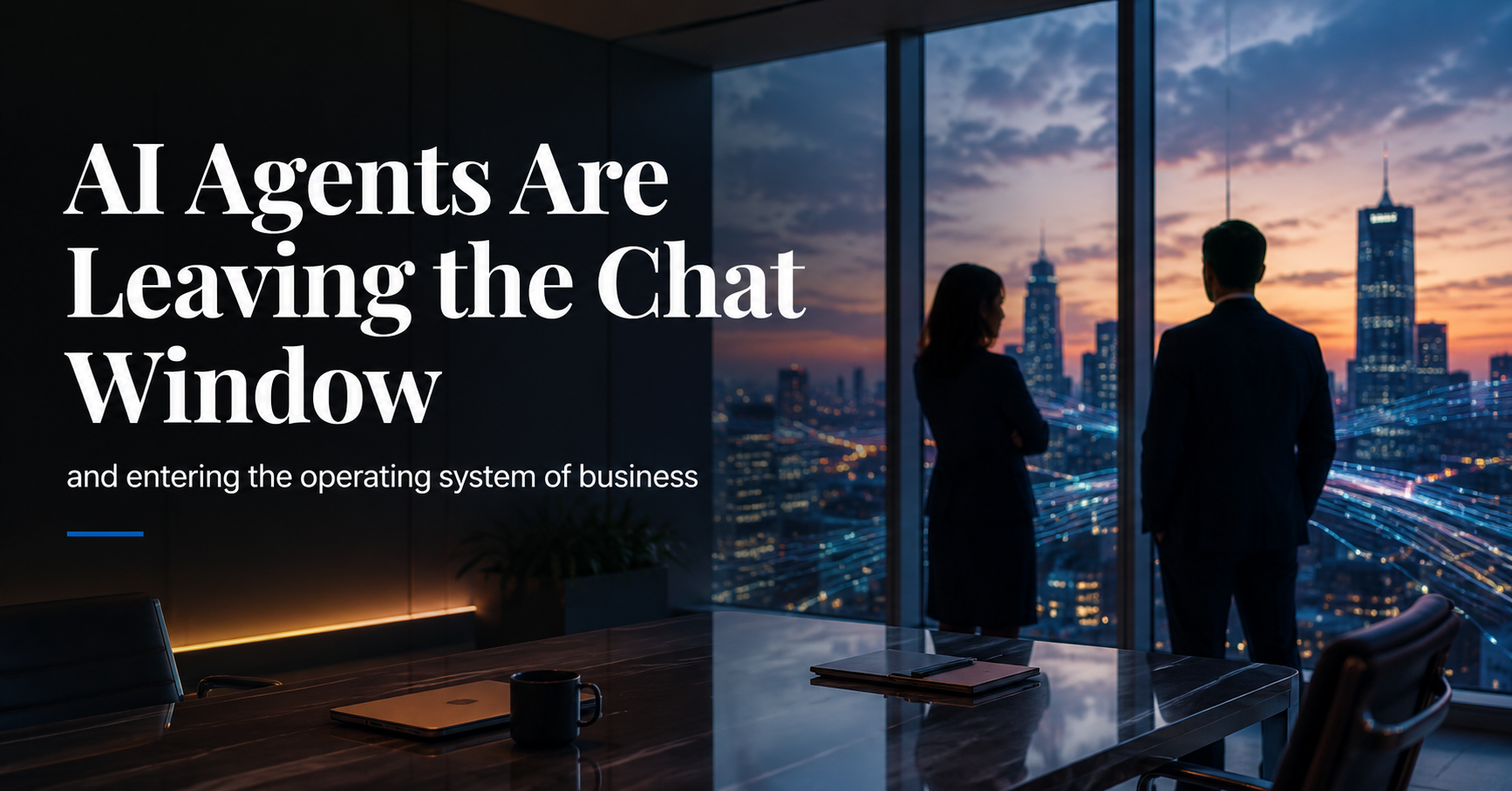
The next phase of artificial intelligence is not about getting better answers. It is about software that can take action, complete workflows and increasingly operate alongside human teams.
For the past several years, artificial intelligence has largely been experienced through a chat box. A user asks a question, the system generates an answer, and a person decides what happens next.
In 2026, that model is beginning to change.
The technology industry is moving rapidly toward AI agents—systems designed not merely to provide information but to perform tasks, interact with software, make decisions within defined limits and complete multi-step workflows.
Gartner has projected that as many as 40% of enterprise applications could include task-specific AI agents by the end of 2026, compared with less than 5% in 2025. That represents a fundamental shift in how businesses may interact with software.
From Answers to Actions
The difference between an AI assistant and an AI agent may sound technical, but its business implications are straightforward.
An assistant might draft an email telling a customer that an appointment is available.
An agent could potentially check the calendar, schedule the appointment, update the customer record, send the confirmation and trigger the appropriate follow-up.
That difference—between recommending an action and executing an action—is becoming one of the most important developments in enterprise technology.
Meta, for example, introduced a Business Agent in June 2026 designed to handle activities such as answering customer questions, qualifying leads, booking appointments and potentially processing transactions. The company said more than one million businesses were already using earlier versions of its business chatbots across WhatsApp and Messenger.
Similar competition across the technology industry suggests that agentic AI is becoming less of a laboratory experiment and more of a commercial product category.
Small Businesses Could Be Major Beneficiaries
Large corporations have obvious reasons to invest in automation, but AI agents could have an even more noticeable impact on smaller companies.
A large enterprise can employ separate teams for customer support, marketing, administration, research and operations. A small company often expects the same person—or the founder—to handle several of those responsibilities.
AI could begin narrowing that operational gap.
The OECD’s 2026 D4SME survey, which examined more than 2,000 small and medium-sized businesses across 12 OECD countries, found that SME adoption of AI is rising rapidly. Most currently rely on off-the-shelf tools, while some have started experimenting with more customized applications and AI agents.
That creates the possibility of a new kind of small company: one where a relatively small human workforce coordinates a much larger digital operating layer.
A five-person business may still have five employees, but those employees could eventually have AI systems handling research, scheduling, routine customer questions, document preparation, data entry and portions of sales administration.
The Real Challenge Is Trust
The excitement surrounding AI agents also introduces a much harder question.
How much authority should software receive?
Allowing an AI system to draft a response is relatively low risk. Allowing it to issue refunds, change customer records, approve purchases or communicate independently with clients requires far stronger controls.
Meta itself has acknowledged the risks that emerge when AI agents are connected deeply to business systems and given permission to act.
The companies that succeed with agentic AI therefore may not be those that automate the largest number of tasks first. They may be those that build the clearest boundaries around what machines can do independently, what requires approval and what must remain entirely human-controlled.
Security, data governance, audit trails and human oversight are becoming just as important as model intelligence.
The OECD has similarly found that although AI adoption among SMEs is growing, secure and strategic integration remains uneven, with skills shortages, implementation costs and limited time among the barriers facing smaller firms.
The Competitive Advantage Will Come From Redesigning Work
There is another reason the AI-agent shift matters.
Simply inserting an AI tool into an old process may produce incremental efficiency. Redesigning the process around what humans and machines each do best could produce something much larger.
Imagine a sales team where an AI system continuously organizes leads, researches prospects and prepares account summaries while humans focus on relationship building and negotiation.
Or a logistics company where agents watch inventory, flag unusual movements, prepare recommendations and coordinate routine actions while managers concentrate on exceptions and strategic decisions.
The technology becomes more valuable when businesses stop asking, “Which employee task can AI copy?” and start asking, “How would we design this operation if intelligent software had always existed?”
2026 May Be Remembered as the Transition Year
Generative AI first attracted mass attention because machines could produce surprisingly human-like text and images.
The next stage may attract attention for a different reason: machines will increasingly be judged by what they accomplish, not simply by what they generate.
Gartner expects the evolution to continue beyond individual task agents toward groups of specialized agents collaborating across applications and business functions.
That future is not guaranteed to arrive smoothly. Technical failures, cybersecurity threats, regulatory questions and organizational resistance will continue to shape adoption.
But the direction is becoming clearer.
The defining question of the AI era is changing from “What can AI tell me?” to “What can AI responsibly do for me?”
For businesses, entrepreneurs and technology leaders, that may prove to be the far more consequential question.
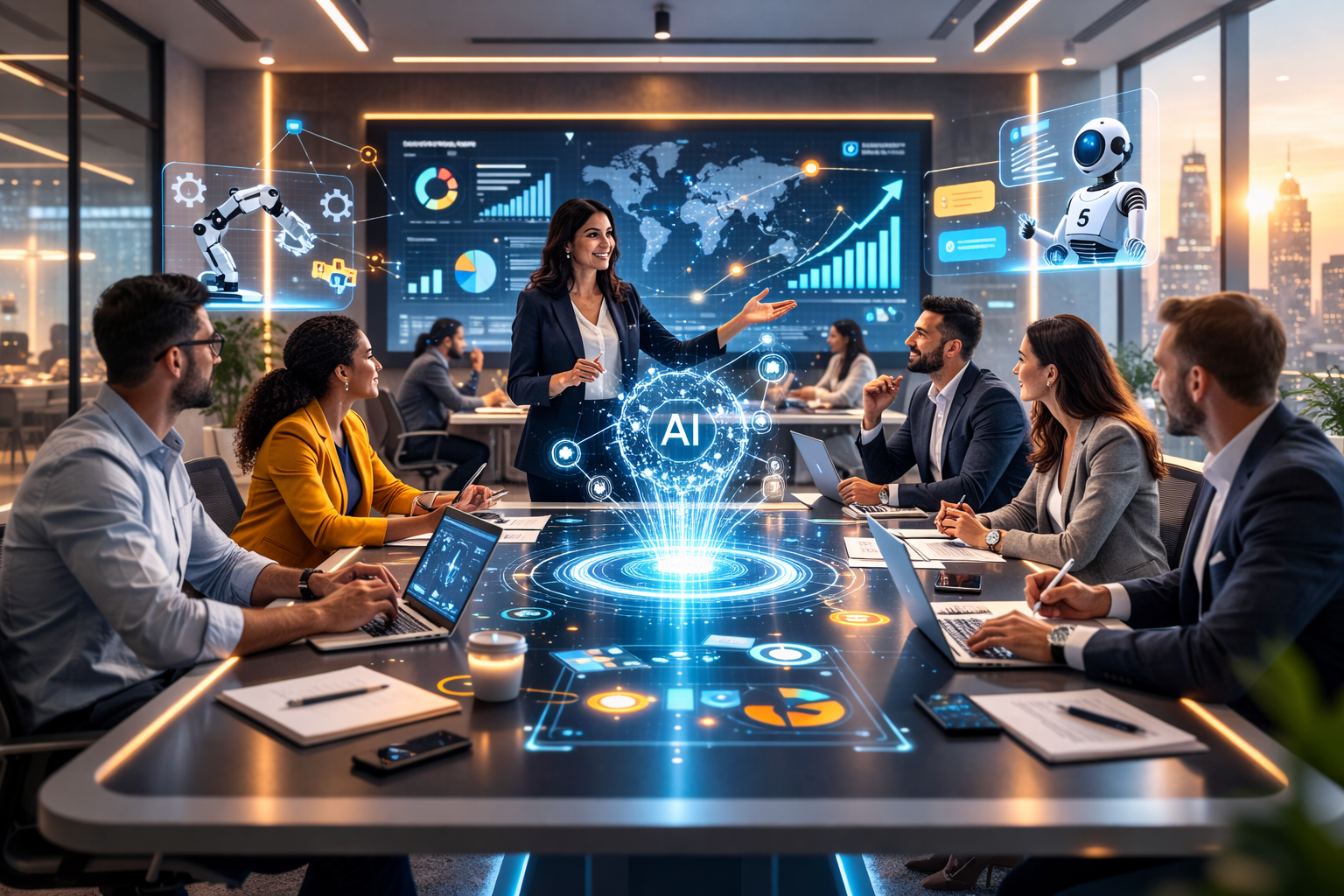
Not long ago, artificial intelligence lived quietly in the background—powering search engines, automating reports, and optimizing supply chains. Today, it sits beside employees as a daily coworker, drafting ideas, analyzing strategy, and influencing decisions in real time. This shift marks more than a technological upgrade; it represents a fundamental rewrite of leadership itself. Managers are no longer leading teams composed solely of people—they are guiding hybrid workforces where human judgment intersects with machine intelligence. As AI moves from tool to collaborator, leadership is being redefined in ways many organizations are only beginning to understand. The question facing executives is no longer whether AI will change work, but whether leaders are prepared to change with it.
From Managing People to Managing Human–AI Collaboration
Gone are the days when leadership was solely about managing people and processes. The rise of AI has shifted the role of leaders from controllers to orchestrators. Now, leaders must harmonize human creativity with AI’s efficiency, leveraging data-driven decision-support systems.
Key challenges for leaders in this new model:
- Determining who does what: What should humans handle? What is best left to AI?
- Shifting focus from control to orchestration, blending human ingenuity with machine precision.
- Designing workflows that optimize both human and machine strengths.
Leadership is no longer about directing a single workforce—it’s about managing a dynamic collaboration between humans and machines.
Decision-Making in the Age of AI Assistance
In an AI-augmented workplace, leaders are not just relying on instinct or experience to make decisions—they’re now balancing intuition with algorithmic insights. With AI providing instantaneous data-driven recommendations, the temptation to follow these outputs blindly is strong. However, the challenge for leaders is to not simply trust AI but to question it, challenge it, and understand its limitations.
New leadership responsibilities include:
- Questioning AI outputs and ensuring they align with organizational goals.
- Balancing intuition with AI insights to make informed decisions.
- Maintaining critical thinking and not blindly relying on AI’s recommendations.
AI can assist, but leaders remain responsible for the final call.
Emotional Intelligence Becomes More Important, Not Less
As AI takes on more analytical tasks, the need for emotional intelligence in leadership only grows. Machines may excel at crunching numbers, but they lack empathy, understanding, and the ability to motivate human teams. Leaders must step up as emotional anchors, providing communication, trust, and psychological safety in a rapidly changing work environment.
Key emotional intelligence skills leaders need:
- Communication to clarify AI’s role and manage expectations.
- Trust-building to reduce employee concerns about AI.
- Psychological safety to create an environment where employees feel valued, not threatened.
- Conflict resolution to address concerns over AI integration and potential job displacement.
Strong leadership in this new AI-augmented world is defined not by technical know-how but by the ability to connect with and support people through technological change.
Redefining Skills and Talent Development
AI’s rise demands a shift in how leaders approach talent development. It’s no longer enough to focus solely on traditional skills. Leaders must foster AI literacy, adaptability, and creative problem-solving across their teams.
Areas leaders should focus on for skill development:
- AI literacy to ensure employees are comfortable working with AI tools.
- Adaptability to respond to ever-changing technological advancements.
- Creative problem-solving to encourage employees to think beyond AI’s capabilities.
- Continuous learning to keep teams evolving as new tools and technologies emerge.
Leaders must cultivate evolving capabilities, coaching their teams to leverage AI while honing skills that machines cannot replicate. The role of leadership shifts from being a manager to being a coach and capability builder.
Ethics, Trust, and Responsible AI Leadership
As AI becomes more integrated into the workplace, it also brings new ethical challenges. Bias in algorithms, privacy concerns, and the risk of over-automation are just a few of the issues leaders must address.
Ethical responsibilities for leaders:
- Establishing guidelines for AI usage to ensure fairness and transparency.
- Ensuring data privacy and protecting employee/customer information.
- Addressing biases in AI algorithms to prevent unintended discrimination.
- Building trust by being transparent about AI’s role in decision-making.
Ethical leadership isn’t just about protecting privacy or avoiding discrimination—it’s about creating a culture of trust, where AI is used to enhance human capabilities rather than diminish them.
The Leader as a Learning Partner with AI
In this new landscape, leaders are no longer the all-knowing authorities they once were. Instead, they must embrace a mindset of continuous learning, staying ahead of the curve by becoming proficient in AI tools themselves.
Shifting leadership responsibilities include:
- Learning AI tools to understand their potential and limitations.
- Modeling curiosity and an eagerness to experiment with new technologies.
- Fostering a culture of collaboration between AI and human expertise.
- Helping teams adapt to AI as a thinking partner, not just a tool to be controlled.
Leaders who adapt to this new dynamic will thrive by fostering an environment of mutual learning between AI and their teams.
Leadership in the AI-Augmented Future
The future of leadership is one where human intuition and AI-driven insights work side by side. As AI becomes an indispensable part of the daily workflow, leaders must evolve from traditional management models to ones that prioritize collaboration, ethical decision-making, and continuous learning. Success in this new era will depend on a leader’s ability to blend technological awareness with emotional intelligence, all while guiding teams through the complexities of an AI-augmented workplace. Leaders who embrace this shift, balancing human understanding with data-driven strategies, will not only survive—they will thrive in the AI-powered future.
-

 Featured2 years ago
20 Entrepreneurs to Watch Closeout 2024
-

 Real Estate2 years ago
Startups Are Looking To Fractionalize Real Estate Assets, But Should They? – Forbes
-

 Innovation2 years ago
Innovators in Social-Emotional Learning: Dr. Myava Clark and Chris Clark Jr.
-

 Music2 years ago
Artist Deydee Signs $350,000 Contract with Rueda Empire LLC
-

 Latest2 years ago
Florida Gov DeSantis signs 15-week abortion ban | Latest News
-

 Uncategorized2 years ago
Trailblazer in Business: Alicia Fitts on Building Wealth and Community Through Faith
-

 Latest2 years ago
Charles zhang recognized by forbes as #1 on michigan’s 2022 best in state wealth advisor list
-

 Real Estate2 years ago
30 Israelis make Forbes 2022 billionaires list, led by Miriam Adelson