
Small Business
Britain’s Small Businesses See Better Times Ahead But Is Their Optimism Justified? – Forbes
Neque porro quisquam est, qui dolorem ipsum quia dolor sit amet, consectetur, adipisci velit, sed quia non numquam eius.


Colin O’Flaherty, Head of Small Business at Barclaycard Payments says SMEs are adapting
So here’s the good news. As the U.K. government prepares to lift almost all Covid-related restrictions, Britain’s small and medium-sized companies seem to be well-placed to raise revenues and profits in 2022.
That’s the headline finding from the latest update of Barclaycard’s SME Barometer. According to the report, revenues are up and many companies are planning to raise staffing numbers in response to increasing demand.
But we’re living in strange and unprecedented times. It’s certainly true that Britain’s economy has bounced back most of the way from the downturn triggered by the pandemic and that is certainly reflected in the Barclaycard figures for SMEs. On the other hand, consumer inflation is running high, hitting 4.9 percent year-on-year in January, with an expectation that it will peak above 7.0 percent in the not too distant future. And as power and gas prices rise again in response to sanctions against Russia, energy-hungry companies face a sharp rise in costs.
A Bullish Mood
So how positive are the Barclaycard figures? Well, it can’t be denied that small businesses are in bullish mood. More than half of the SMEs taking part in the survey reported a rise in earnings in the last quarter of 2021 when compared with the same period a year earlier.
A separate report published by accountancy software company Xero paints a similar picture. The January update to its Small Business Index finds that sales rose 3.7 percent year-on-year in January when averaged out to take account of the impact of Covid.
Arguably none of this is surprising. The final three months of 2020 were marked by a sequence of ever more stringent Covid restrictions, culminating in a lockdown over the Christmas period. And while a huge amount of uncertainly hung over the last quarter of 2021, businesses had to some degree learned to adapt. Added to that, the economy as a whole was recovering in fits and starts.
Future Prospects
And Britain’s SMEs seem to be optimistic about the year ahead. According to the survey, businesses are expecting revenues to rise by an average of 13.5 percent in the first quarter of the year. Buoyed by an increase in demand, two-fifths of the companies surveyed expect to make an average of six new hires in the coming months.
But there are warning signs that the months ahead could be difficult. Certainly, SMEs are extremely concerned about inflation. Businesses are seeing their own costs rising at a time when customers – also squeezed by rising prices – have less to spend.
Offline to Online
Two-thirds of SMEs said they were concerned about rising prices in general and energy bills in particular, with four in ten seeing it as a threat to their competitiveness. And inflation could force a radical change in business practices. According to the report, nearly 10 per cent of businesses are reconsidering the need for physical outlets. It seems the economic fallout pandemic is continuing to accelerate the move from offline to online.
Staff shortages also threaten the SME recovery. UK employment rates are high and the economy as a whole has around one million unfilled vacancies. Companies planning to take on new staff may have to work hard to attract the right people and pay more when they do. This is reflected in the Xero research. It reports wage rises of 4.4 percent in January, although this falls to 2.7% when averaged out over the two years of the Covid crisis.
Some businesses appear to be feeling the strain. Xero reports that the average payment time to customers was pushed back by 1.9 days in January and many payments were made beyond the agreed terms. Average lateness was 8.9% days. Typically businesses begin to pay later when their own cashflow is stressed.
The Wider Picture
And if you step back from Barclaycard’s report, there are plenty of other issues to worry small companies. For those who either import or export to or from the E.U., it has to be a concern that trade between Britain and continental Europe dipped in the wake of new rules coming into force in the wake of Brexit. There has been some recovery, but according to the House of Commons Public Accounts Committee, SMEs have been particularly badly hit by increased costs and paperwork.
Barclaycard says that SMEs are responding to the economic challenges. As Colin O’Flaherty, Head of Small Business at Barclaycard Payments, observed: “SMEs are also remaining resilient by continuing to focus on areas within their control, such as by improving their operating models to overcome the hangover to supply chain disruption which peaked at the end of last year.»
So it’s a mixed picture for Britain’s SMEs. Those that have survived two years of Covid restrictions are hopeful of better times ahead, but no one can ignore the increasingly challenging economic trends. The sector is not out of the woods just yet.








Why Black Women Need to Speak Up About Bad Partnerships—and Why “I Want Out” Is Opening the Conversation
How many women have to get burned before we stop treating silence like loyalty?
A partnership can begin with excitement, shared goals, and promises of what you will build together. You bring your ideas, your relationships, your money, and your name. You believe that the person beside you wants to see you win.
Then something changes.
The promises become excuses. The responsibilities become uneven. Questions about money lead to arguments. Your contributions are overlooked, but your commitment is still expected.
And when you finally consider leaving, you face another question: What will people say?
For Black women navigating business, leadership, and community relationships, that question can carry weight. Will speaking up make you look difficult? Will people accuse you of tearing someone down? Will telling the truth cost you opportunities?
Those fears deserve an honest conversation. So does the price of keeping everything hidden.

The Partnership Can End. The Damage Can Follow.
A bad partnership can cost more than money.
It can affect your confidence, your reputation, and your willingness to trust yourself. You may find yourself questioning decisions you once felt certain about. You may hesitate to pursue another opportunity because the last one left you exhausted.
Sometimes the hardest part is admitting that something you worked so hard to build is hurting you.
You keep remembering the original vision. You hope one more conversation will fix the problem. You tell yourself that leaving would mean everything you invested was wasted.
But how much more must you lose before you give yourself permission to move forward?
You can believe in collaboration and still recognize when a particular partnership needs to end.
Black Women Deserve Room to Tell the Whole Story
There is room to celebrate Black women’s strength while also making space for their disappointment, anger, and pain.
We should be able to say, “This happened, and it hurt me,” without having to prove that we are strong enough to handle it alone.
We should be able to ask questions about a partnership without being labeled disloyal. We should be able to set boundaries without being called selfish. And we should be able to leave an unhealthy situation without carrying all the blame for its failure.
Supporting our community must include accountability within our community.
A shared background, a familiar face, or an impressive platform does not remove the need for honest communication and follow-through.
We deserve partnerships where respect is visible in the work, the decisions, and the way concerns are handled.
Your Experience Could Help Another Woman Recognize the Warning Signs
When women share what they have learned, others gain something they may desperately need: a clearer picture of what to watch for.
Someone may recognize the pattern of unanswered questions. Someone may realize she has been carrying responsibilities that were supposed to be shared. Someone may finally understand why she feels uncomfortable, even though everyone around her keeps calling the opportunity a blessing.
Speaking up can mean sharing the questions you wish you had asked, the boundaries you wish you had set, or the moment you realized you needed to leave.
It does not require sharing every private detail. A truthful account of your own experience can teach a powerful lesson.
And women who are not ready to speak publicly deserve support, too. The responsibility for harmful behavior belongs to the person who caused it. Sharing a story should be a choice made with care.
For the woman who is ready, her experience may become the warning she wishes someone had given her.
“I Want Out” Is Making Space for This Conversation
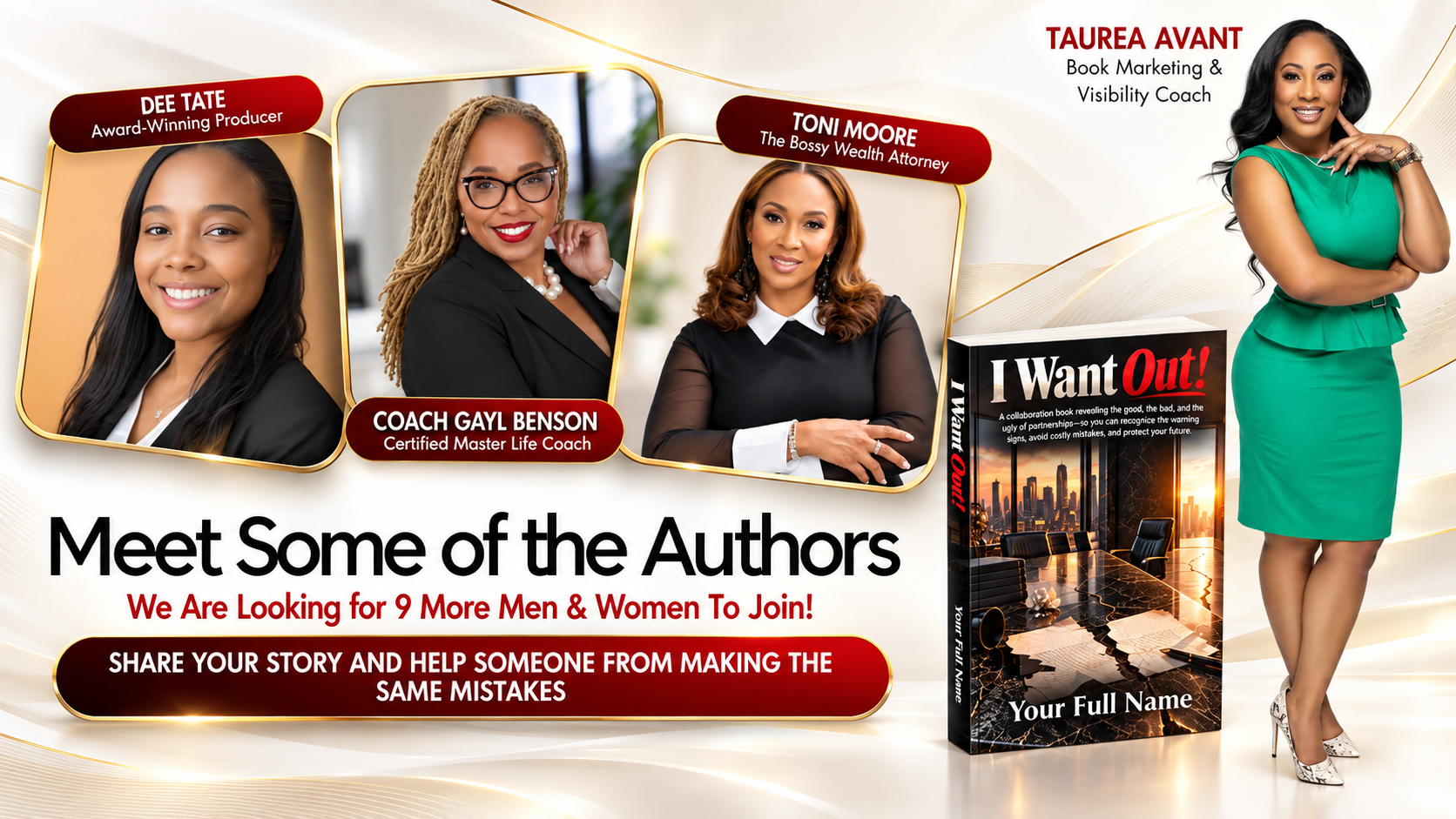
The forthcoming collaboration book “I Want Out” brings this conversation into the open.
A collaboration book revealing the good, the bad, and the ugly of partnerships—so you can recognize the warning signs, avoid costly mistakes, and protect your future.
The project creates an opportunity for women and men to share experiences and lessons from partnerships—and to help others think more carefully about what they enter, what they accept, and when they choose to leave.
Among the women participating are Toni Moore, Dee Tate, and Coach Gayl Benson, whose professional backgrounds bring different perspectives to the conversation.
Toni Moore is an attorney and business strategist. Her website includes education for entrepreneurs on protecting their brands through trademark knowledge, adding a business protection perspective to the group.
Dee Tate is an award-winning film producer, multidisciplinary artist, poet, and author whose work explores faith, healing, identity, and becoming. She founded Chicago Production Assistants in 2016, growing a community of more than 7,000 members. Her work encourages people to recognize their lived experiences as a source of purpose, creativity, and impact.
Coach Gayl Benson is a Certified Master Life and Cognitive Behavior Coach who helps women challenge limiting beliefs and move toward their next chapter. Through her L.I.E.—Let It End—framework, she guides women in examining the stories they have accepted about themselves and recognizing their power to choose what comes next.
Their backgrounds reflect the range of voices this conversation needs: business knowledge, creative expression, and personal growth.
Meet the Woman Bringing “I Want Out” Together
“I Want Out” is being put together by Taurea “Vision” Avant, who is bringing contributors together to share honest stories and help others make more informed partnership decisions.
Taurea “Vision” Avant is a two-time TEDx speaker, author, and founder of Book Profits Club™. She helps authors, speakers, coaches, and entrepreneurs turn their books into tools for visibility, business growth, and income. Having spoken in more than 10 countries, Taurea brings an international perspective to helping people share their stories with purpose. Through publishing support, collaboration books, training, and media opportunities, she guides authors beyond writing toward building a platform. She also created Author Allstars™ Magazine to spotlight authors worldwide. Her mission is to help 1,000 authors earn more than $10,000 monthly by building businesses around their books.
We Are Looking for More Women and Men to Join Us
Have you experienced a partnership that left you saying, “I want out”?
Did you learn a difficult lesson about trust, boundaries, accountability, or walking away? Could sharing your experience help someone recognize the warning signs sooner or feel less alone?
We are inviting more women and men to become coauthors of “I Want Out.” While this article highlights Black women’s voices, the book welcomes both women and men who want to share honest experiences and valuable lessons about partnerships.
Your story does not have to end with everything perfectly resolved. What you have learned may give someone else the clarity or courage to make a better decision.
To learn about the book and becoming a coauthor, register for the information session at iwantout.collaborationbooks.com.
You cannot change what happened. But your voice may help someone else change what happens next.
Leadership
From Book to Booked: Taurea Avant Shares How Authors Can Use AI to Land More Speaking Opportunities

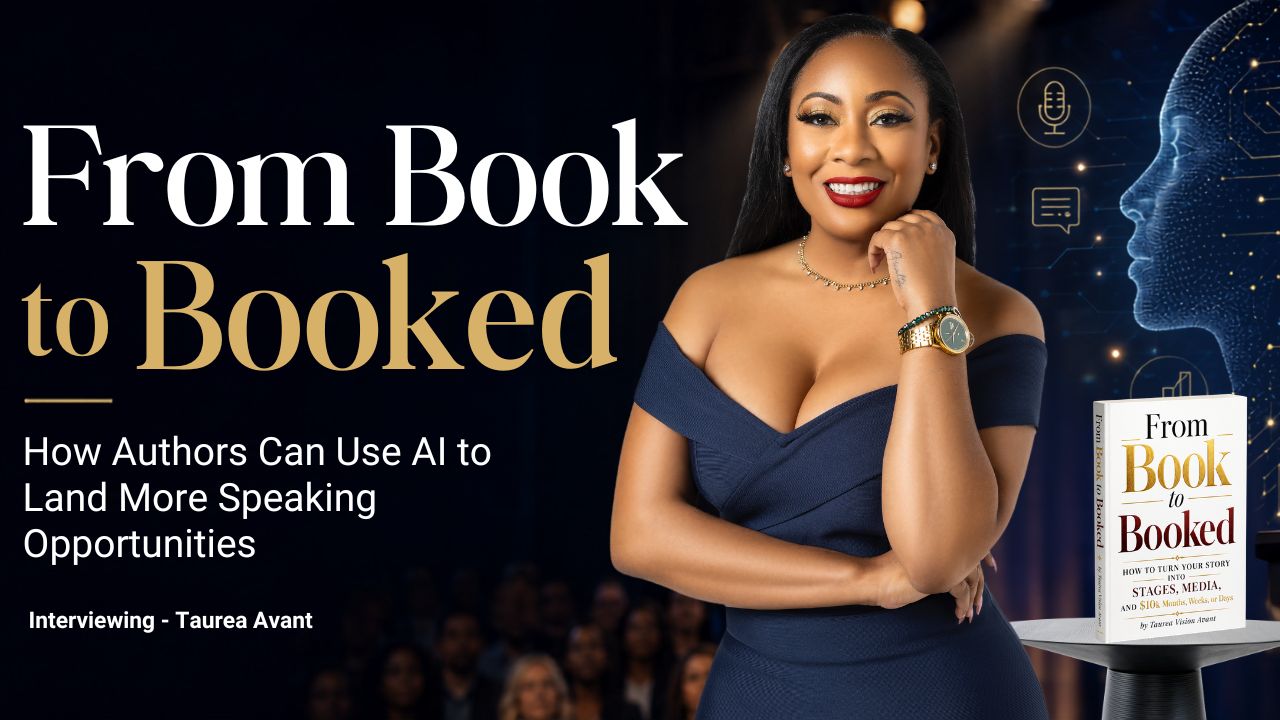
For many authors, publishing a book feels like the finish line. Visibility strategist, international speaker, and bestselling author Taurea Avant sees it differently. In her view, publishing the book is often just the beginning of a much bigger opportunity.
Avant has built her work around helping authors, speakers, coaches, and experts turn their knowledge and stories into visibility, stages, media opportunities, and revenue. Through her “From Book to Booked” approach, she encourages authors to stop looking at their books only as products to sell and start viewing them as strategic business tools.
“Writing the book is not necessarily the hardest part,” Avant explains. “The bigger challenge is figuring out what to do with the book once it is finished. A lot of authors publish the book, put it on Amazon, announce it to their audience, and then they are not really sure what comes next.”
According to Avant, what comes next should be a clear strategy for expanding the message beyond the pages.
A Book Can Become a Speaking Credential
For authors who also want to speak, Avant believes the book can provide an immediate credibility boost. It gives event organizers, podcast hosts, media outlets, and potential clients something tangible that represents the author’s knowledge and expertise.
However, simply being a published author is not enough.
“The goal is not to get on stage and spend 30 or 45 minutes talking about your book,” Avant says. “The goal is to identify the transformation inside the book. What can you teach? What can the audience learn from your story? What problem can your experience help someone solve?”
That shift in thinking can completely change how an author approaches speaking opportunities.
A leadership author, for example, can develop talks around leadership development, team building, workplace culture, or personal growth. An entrepreneur who has written about business can create presentations around sales, marketing, resilience, branding, or entrepreneurship. Someone who has written a personal story can identify the lessons within that experience and turn those lessons into keynote presentations, workshops, or panel topics.
Avant encourages authors to start by looking at something they already have: their table of contents.
“Your chapters can become speaking topics,” she says. “One chapter may become a keynote. Another may become a workshop. Another may become a podcast conversation. Authors sometimes think they need to keep creating completely new content when they may already have months of speaking content sitting inside their book.”
AI Is Changing How Authors Can Position Themselves
The rise of artificial intelligence has created concerns for many writers and authors, especially around originality and the future of publishing. Avant believes authors should pay attention to those concerns, but she also sees tremendous opportunity in using AI as a business and visibility tool.
“AI should not replace your story, your experience, or your voice,” she explains. “But it can help you organize and leverage what you already know much faster.”
For an author looking to expand into speaking, that could mean using AI to brainstorm presentation topics based on a book, strengthen a speaker bio, create podcast pitch ideas, develop workshop outlines, prepare interview talking points, or identify audiences that may benefit from the author’s message.
An author could take the summary of a chapter, for example, and ask an AI tool to suggest five potential keynote topics. From there, the author can decide which ideas fit their expertise, audience, and voice.
“You still have to bring yourself to it,” Avant says. “AI may give you an idea, but your experience is what makes that idea powerful.”
AI can also help authors think more strategically about where their message belongs. Rather than randomly searching for stages, Avant recommends first identifying the audience, the problem that audience faces, and the transformation the speaker provides. AI can then be used to brainstorm types of conferences, organizations, podcasts, associations, and companies where that topic may be relevant.
Visibility Often Leads to More Visibility
One of the biggest lessons Avant teaches speakers is that getting booked can often lead to getting booked again.
Event organizers and podcast hosts regularly research potential guests before making a decision. When they search a speaker’s name, they may look for previous interviews, articles, speaking clips, media coverage, and other evidence that the person has experience delivering their message publicly.
“People are going to look you up,” Avant says. “The question is, what are they going to find?”
This is why she encourages speakers to treat every opportunity as part of a larger visibility strategy. A podcast appearance can become a video clip. A speaking engagement can become photographs, testimonials, and social media content. An article can strengthen credibility when pitching another publication or conference.
Over time, those individual opportunities create what Avant describes as a visibility trail.
“The more evidence people can find that you are already speaking, being interviewed, and sharing your expertise, the easier it becomes for them to imagine you on their stage,” she explains.
That does not mean every opportunity needs to be massive. Avant believes many speakers make the mistake of focusing only on large conferences while overlooking smaller stages that may place them directly in front of the right audience.
“Thirty of the right people can sometimes create a bigger opportunity than 3,000 people who are not your audience,” she says.
Authors Should Think Beyond Book Royalties
Avant also challenges authors to think differently about how a book can generate revenue.
Most authors naturally think first about book sales. Yet the financial opportunity connected to a book can extend much further.
A book may sell for $20, but the authority created by that book can lead to speaking engagements, coaching clients, consulting contracts, partnerships, workshops, media appearances, and other opportunities worth considerably more.
“The book can be one of the least expensive things you offer, but it can be one of the most powerful tools for introducing people to everything else you do,” Avant says.
That is the core of the “From Book to Booked” philosophy. The objective is not simply to sell more books. It is to use the book to create a larger ecosystem around the author’s expertise.
When that happens, the book becomes the introduction, the speaking opportunity expands the message, and the business gives the audience a way to continue working with the author.
The First Step Is Getting Clear
For an author who wants to begin landing more speaking opportunities, Avant recommends starting with clarity.
What do you want to be known for? Who needs your message? What transformation can you provide? What type of stage already attracts those people?
Once those answers become clear, the next step is consistent visibility and pitching.
“The biggest mistake is waiting for someone to discover you,” Avant says. “You have to start putting yourself in the rooms, conversations, interviews, and platforms where your message belongs.”
With the continued growth of podcasts, virtual platforms, live conferences, digital media, and AI tools, authors now have more ways than ever to turn one book into multiple opportunities.
The book may start the conversation, but it does not have to be where the conversation ends.
Learn How to Speak on More Stages
Avant is continuing this conversation through her How to Speak on More Stages Workshop, designed for authors, speakers, coaches, entrepreneurs, and experts who want to increase their visibility and create more speaking opportunities.
The workshop will cover how to position a message for the right stages, develop stronger speaking topics, leverage a book as a credibility tool, identify opportunities, and use AI to help make the visibility process faster and more strategic.
To learn more or register, visit www.HowtoSpeakonMoreStages.com.
Small Business
Small Business Confidence Is Rising Again—But Growth Comes With a New Set of Challenges

After months of economic uncertainty, there are signs that America’s small-business economy is regaining some momentum. Entrepreneurs are starting companies at a faster pace, existing business owners are becoming more optimistic, and more employers are preparing to hire.
But this is not a return to easy growth.
The small-business environment of 2026 is increasingly defined by a different challenge: owners may see opportunities to expand, but finding the right employees, managing financing costs, protecting margins and making smart investments are becoming critical to turning optimism into sustainable growth.
Confidence Is Returning to Main Street
The latest numbers offer an encouraging picture.
The National Federation of Independent Business reported that its Small Business Optimism Index increased 2.4 points to 99.8 in July 2026, putting it above its long-term average of 98 and at its highest level since August 2025. Eight of the index’s ten components improved during the month.
Perhaps more important is what business owners intend to do next.
A seasonally adjusted net 20% of small-business owners said they planned to create jobs during the next three months, the strongest hiring intention recorded since October 2022. Meanwhile, 25% planned capital expenditures during the next six months, the highest level since December 2024.
That combination suggests small-business owners are not simply feeling more confident. Many are beginning to think about expansion again.
And new entrepreneurs continue to enter the market.
The U.S. Census Bureau reported 578,926 business applications in July 2026, seasonally adjusted, an 8.1% increase from June. The agency projected nearly 30,000 new employer businesses would emerge within four quarters from July’s applications.
Entrepreneurial activity, in other words, remains alive and well.
The Biggest Problem Is Shifting
For much of the past several years, inflation dominated business conversations. Rising materials, transportation, energy and operating expenses forced many small companies to increase prices or accept thinner margins.
Those pressures have not disappeared, but the latest data suggest the concern is changing.
In July, 14% of surveyed small-business owners identified inflation as their most important business problem, down seven percentage points from June. At the same time, 27% identified labor quality or availability as their biggest problem, making workforce issues the leading concern.
Thirty-six percent reported job openings they could not fill, the highest percentage since June 2025. Among businesses hiring or attempting to hire, a large majority reported receiving few or no qualified applicants.
That creates an unusual situation.
Businesses increasingly want to hire at the same time that many cannot find the people they need.
For small companies, this problem can be particularly serious. Large corporations may have dedicated recruiters, larger salary budgets and stronger employer brands. A business with 10 or 20 employees often does not have those advantages.
The result is that the next stage of small-business competition may be fought as much over talent as customers.
Small Businesses Need to Rethink Hiring
Throwing another job listing online may no longer be enough.
Owners looking to expand should increasingly think about the employee experience in much the same way they think about the customer experience.
Competitive pay matters, but so do scheduling flexibility, career development, workplace culture, training and clear opportunities for advancement.
Small businesses can also compete in ways that larger companies sometimes cannot.
They can give employees greater responsibility earlier. They can make decisions faster. Employees may have more direct access to leadership and a clearer understanding of how their work affects the company.
Those advantages need to become part of the recruiting message.
Businesses should also reconsider whether every position requires an experienced candidate. When qualified talent is scarce, hiring capable people and developing them internally can sometimes be more effective than waiting months for a perfect résumé.
Growth Still Needs Financial Discipline
Improving confidence should not be confused with inexpensive money.
NFIB’s July survey found that the average interest rate owners reported paying on short-maturity loans was 7.9%. Meanwhile, Federal Reserve lending data showed that credit standards remained toward the tighter end of their historical range across many lending categories, even as conditions for commercial and industrial lending were relatively more accommodating.
That means expansion decisions need to be deliberate.
Buying equipment, opening another location or adding employees may create growth, but only when the expected return justifies the cost.
Owners should know three numbers before committing to major expansion: the additional monthly cost, the realistic revenue the investment can generate, and how long the business can comfortably carry the expense if sales develop more slowly than expected.
In an uncertain economy, cash reserves and flexibility can be just as valuable as rapid growth.
Protecting Margins Matters More Than Chasing Revenue
Revenue growth looks impressive, but profitability keeps businesses alive.
Small-business owners should therefore pay close attention to which products, customers and services actually produce their strongest margins.
Some businesses may discover that a relatively small group of customers generates most of their profit. Others may find that an apparently popular product consumes too much labor, inventory or delivery expense to remain worthwhile.
The strongest companies will use this period of improving confidence to become more selective—not simply bigger.
That could mean eliminating low-margin offerings, renegotiating supplier contracts, introducing minimum order requirements, adjusting pricing or focusing sales efforts on the customers most likely to become profitable long-term relationships.
The Opportunity Is Real, but So Is the Uncertainty
The current numbers are encouraging, but business owners are hardly carefree.
NFIB’s Uncertainty Index increased to 91 in July, remaining well above its historical average. Sales expectations also softened slightly even as overall confidence improved.
That combination captures the current small-business environment remarkably well.
Owners are optimistic enough to invest.
They are cautious enough to know conditions can change.
That may actually be a healthy combination.
The businesses positioned to perform best in the next phase are unlikely to be those that expand at any cost. They will be companies that grow selectively, recruit creatively, control expenses, preserve cash and remain close enough to their customers to recognize changes in demand early.
A New Phase for Small Business
Small-business optimism returning above its long-term average is meaningful. Rising business applications are meaningful too.
They show that entrepreneurs continue to believe there are opportunities worth pursuing despite a complicated economic environment.
But 2026 is also demonstrating that optimism alone does not build a successful company.
Execution does.
For entrepreneurs, the opportunity now is to turn improving confidence into stronger businesses without repeating the mistakes that often accompany rapid expansion.
The next winners in small business may not be the companies that grow the fastest. They may be the ones that learn how to grow without losing control.
-

 Featured2 years ago
20 Entrepreneurs to Watch Closeout 2024
-

 Real Estate2 years ago
Startups Are Looking To Fractionalize Real Estate Assets, But Should They? – Forbes
-

 Innovation2 years ago
Leo Horacio: A Successful Entrepreneur in the Ecommerce and Online Sales Industry
-

 Innovation2 years ago
Innovators in Social-Emotional Learning: Dr. Myava Clark and Chris Clark Jr.
-

 Music2 years ago
Artist Deydee Signs $350,000 Contract with Rueda Empire LLC
-
 Latest2 years ago
Florida Gov DeSantis signs 15-week abortion ban | Latest News
-
 Uncategorized2 years ago
Trailblazer in Business: Alicia Fitts on Building Wealth and Community Through Faith
-

 Latest2 years ago
Charles zhang recognized by forbes as #1 on michigan’s 2022 best in state wealth advisor list