
Innovation
When Women Went to Space – And the Internet Exploded


On April 14, 2025, a new page in space history was written—not by NASA, but by six women from vastly different industries who hitched a ride to the edge of space aboard Blue Origin’s New Shepard rocket. Dubbed as a celebration of female empowerment and modern exploration, the trip was anything but universally praised.
Let’s break it down: The all-female crew included pop superstar Katy Perry, broadcast legend Gayle King, aerospace engineer Aisha Bowe, activist Amanda Nguyen, film producer Kerianne Flynn, and pilot Lauren Sánchez—also known as Jeff Bezos’ partner. It was the first time a full crew of women entered suborbital space aboard a commercial flight, and yes, it made headlines. But alongside the applause came serious questions about the cost, the purpose, and the message it sends to a world still battling inequality and climate crises.
How Much Did It Cost?
While Blue Origin hasn’t released exact numbers for this particular flight, previous seats on New Shepard have ranged between $250,000 and $1 million per person. So, if we do some quick math, the collective cost of sending these six women to the edge of space likely ran up to $6 million—or more.
But who footed the bill? That part’s murky. Some of the crew may have been sponsored, while others, like Lauren Sánchez and Katy Perry, could likely afford the ticket out of pocket. Still, when millions are spent on a 10-minute joyride that offers weightlessness, Earth views, and instant headlines, people are bound to talk.
Inspiration or Extravagance?
Supporters argue this flight was historic, inspiring, and exactly what young girls around the world need to see. Representation matters, and seeing six accomplished women—especially women of color like Aisha Bowe and Amanda Nguyen—suit up and fly above the planet was undeniably powerful. Gayle King herself said the moment was “bigger than space—it’s about possibility.”
But not everyone bought the “empowerment” narrative. Social media lit up with criticism, with some calling it a “millionaire flex disguised as feminism.” Celebrities like Olivia Munn and Emily Ratajkowski publicly questioned the impact of the flight, with Munn tweeting, “Women breaking boundaries is powerful. Billionaires playing astronaut for fun? Not so much.”
Critics raised valid points. What exactly did the mission accomplish, besides another notch in Blue Origin’s PR belt? Did it serve science, or just egos?
The Environmental Cost
Beyond the price tag and public optics, environmentalists jumped into the fray. Space launches are resource-heavy, and every suborbital flight like New Shepard’s emits tons of carbon dioxide and other pollutants into the upper atmosphere.
In a time when climate change is no longer a future threat but a current reality, burning through that much fuel for what many see as a “selfie in space” moment feels irresponsible. For every inspirational Instagram post shared from the flight, there’s an environmental impact report saying, “Maybe not the best idea.”
The Bigger Picture: Who Gets to Go?
Another layer to this controversy is access. Space tourism is being positioned as the next luxury experience, but it’s only available to the ultra-wealthy or the ultra-connected. This latest trip, though historic in its makeup, reminded many that most people—especially women in underserved communities—are still fighting for basic resources, not zero-gravity snapshots.
And let’s be real: Is representation still empowering if it only comes in designer space suits? Lauren Sánchez may have piloted the helicopter that took her to training, but most women can’t even get a loan for a small business. The contrast is jarring.
Not All Bad
Still, to be fair, there were aspects of the mission that went beyond fluff. Amanda Nguyen, a Nobel Peace Prize nominee, used her platform to speak on global justice. Aisha Bowe, a real rocket scientist, talked about bridging the STEM gap for minority youth. There were also scientific payloads on board and ongoing partnerships with educational outreach programs that bring space science to classrooms.
So, while the optics may be bougie, there was at least an effort to turn the flight into something meaningful.
Final Thoughts
This mission was layered. It was empowering and elitist. Groundbreaking and tone-deaf. Inspirational and indulgent. That’s what makes it so fascinating—and so frustrating.
On one hand, we witnessed a cultural milestone: women, once completely excluded from space exploration, now boldly leading their own missions. On the other hand, it highlighted just how far we have to go when it comes to equity—not just in space, but right here on Earth.
Whether this flight will spark lasting change or be remembered as a well-marketed stunt remains to be seen. But one thing is clear: the conversation around who gets to go to space, why they go, and what they do with that opportunity is only just beginning.
And maybe that’s the real launch we should be paying attention to.


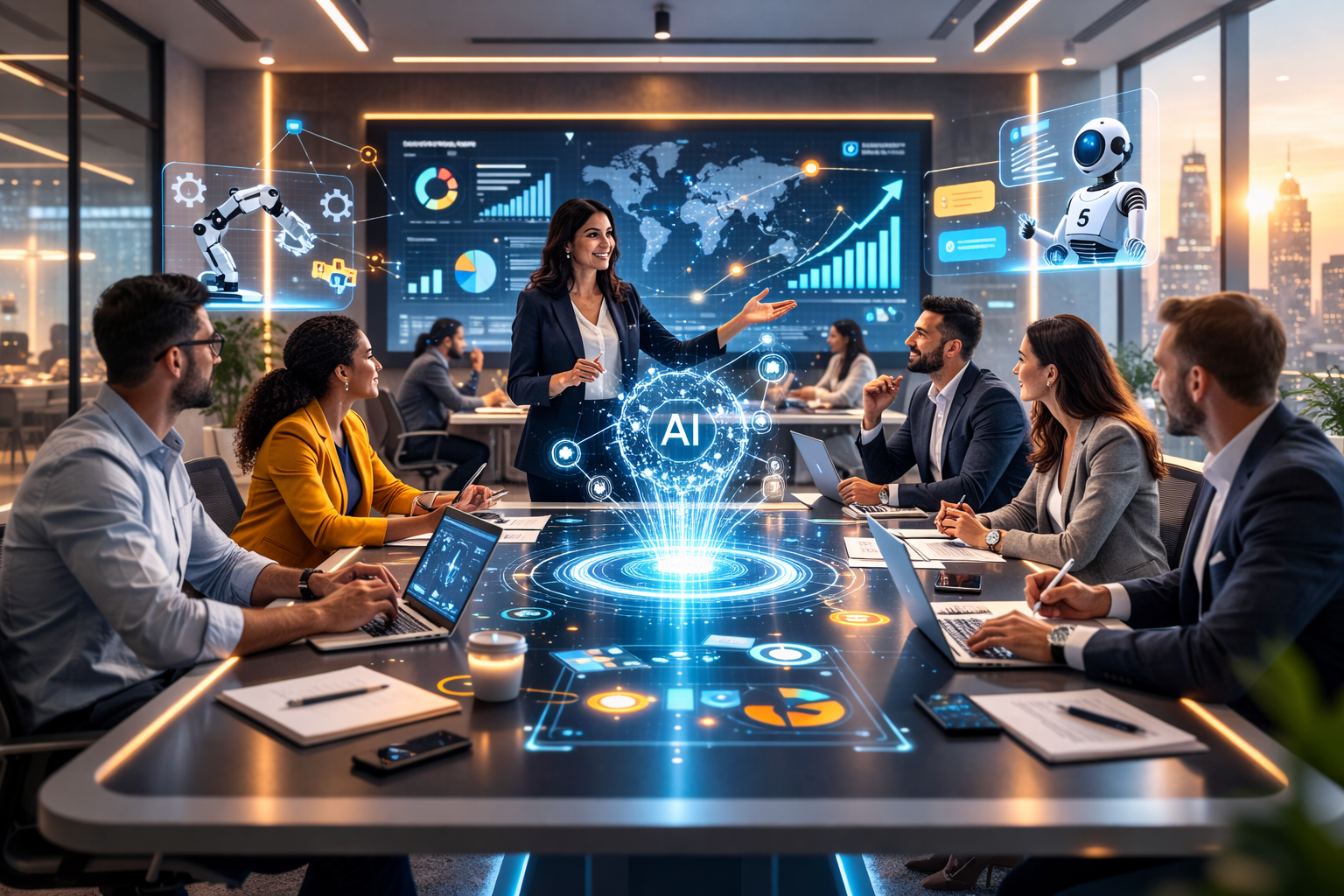
Not long ago, artificial intelligence lived quietly in the background—powering search engines, automating reports, and optimizing supply chains. Today, it sits beside employees as a daily coworker, drafting ideas, analyzing strategy, and influencing decisions in real time. This shift marks more than a technological upgrade; it represents a fundamental rewrite of leadership itself. Managers are no longer leading teams composed solely of people—they are guiding hybrid workforces where human judgment intersects with machine intelligence. As AI moves from tool to collaborator, leadership is being redefined in ways many organizations are only beginning to understand. The question facing executives is no longer whether AI will change work, but whether leaders are prepared to change with it.
From Managing People to Managing Human–AI Collaboration
Gone are the days when leadership was solely about managing people and processes. The rise of AI has shifted the role of leaders from controllers to orchestrators. Now, leaders must harmonize human creativity with AI’s efficiency, leveraging data-driven decision-support systems.
Key challenges for leaders in this new model:
- Determining who does what: What should humans handle? What is best left to AI?
- Shifting focus from control to orchestration, blending human ingenuity with machine precision.
- Designing workflows that optimize both human and machine strengths.
Leadership is no longer about directing a single workforce—it’s about managing a dynamic collaboration between humans and machines.
Decision-Making in the Age of AI Assistance
In an AI-augmented workplace, leaders are not just relying on instinct or experience to make decisions—they’re now balancing intuition with algorithmic insights. With AI providing instantaneous data-driven recommendations, the temptation to follow these outputs blindly is strong. However, the challenge for leaders is to not simply trust AI but to question it, challenge it, and understand its limitations.
New leadership responsibilities include:
- Questioning AI outputs and ensuring they align with organizational goals.
- Balancing intuition with AI insights to make informed decisions.
- Maintaining critical thinking and not blindly relying on AI’s recommendations.
AI can assist, but leaders remain responsible for the final call.
Emotional Intelligence Becomes More Important, Not Less
As AI takes on more analytical tasks, the need for emotional intelligence in leadership only grows. Machines may excel at crunching numbers, but they lack empathy, understanding, and the ability to motivate human teams. Leaders must step up as emotional anchors, providing communication, trust, and psychological safety in a rapidly changing work environment.
Key emotional intelligence skills leaders need:
- Communication to clarify AI’s role and manage expectations.
- Trust-building to reduce employee concerns about AI.
- Psychological safety to create an environment where employees feel valued, not threatened.
- Conflict resolution to address concerns over AI integration and potential job displacement.
Strong leadership in this new AI-augmented world is defined not by technical know-how but by the ability to connect with and support people through technological change.
Redefining Skills and Talent Development
AI’s rise demands a shift in how leaders approach talent development. It’s no longer enough to focus solely on traditional skills. Leaders must foster AI literacy, adaptability, and creative problem-solving across their teams.
Areas leaders should focus on for skill development:
- AI literacy to ensure employees are comfortable working with AI tools.
- Adaptability to respond to ever-changing technological advancements.
- Creative problem-solving to encourage employees to think beyond AI’s capabilities.
- Continuous learning to keep teams evolving as new tools and technologies emerge.
Leaders must cultivate evolving capabilities, coaching their teams to leverage AI while honing skills that machines cannot replicate. The role of leadership shifts from being a manager to being a coach and capability builder.
Ethics, Trust, and Responsible AI Leadership
As AI becomes more integrated into the workplace, it also brings new ethical challenges. Bias in algorithms, privacy concerns, and the risk of over-automation are just a few of the issues leaders must address.
Ethical responsibilities for leaders:
- Establishing guidelines for AI usage to ensure fairness and transparency.
- Ensuring data privacy and protecting employee/customer information.
- Addressing biases in AI algorithms to prevent unintended discrimination.
- Building trust by being transparent about AI’s role in decision-making.
Ethical leadership isn’t just about protecting privacy or avoiding discrimination—it’s about creating a culture of trust, where AI is used to enhance human capabilities rather than diminish them.
The Leader as a Learning Partner with AI
In this new landscape, leaders are no longer the all-knowing authorities they once were. Instead, they must embrace a mindset of continuous learning, staying ahead of the curve by becoming proficient in AI tools themselves.
Shifting leadership responsibilities include:
- Learning AI tools to understand their potential and limitations.
- Modeling curiosity and an eagerness to experiment with new technologies.
- Fostering a culture of collaboration between AI and human expertise.
- Helping teams adapt to AI as a thinking partner, not just a tool to be controlled.
Leaders who adapt to this new dynamic will thrive by fostering an environment of mutual learning between AI and their teams.
Leadership in the AI-Augmented Future
The future of leadership is one where human intuition and AI-driven insights work side by side. As AI becomes an indispensable part of the daily workflow, leaders must evolve from traditional management models to ones that prioritize collaboration, ethical decision-making, and continuous learning. Success in this new era will depend on a leader’s ability to blend technological awareness with emotional intelligence, all while guiding teams through the complexities of an AI-augmented workplace. Leaders who embrace this shift, balancing human understanding with data-driven strategies, will not only survive—they will thrive in the AI-powered future.

Technology is no longer evolving in predictable cycles — it is advancing in disruptive waves that are redefining entire industries in real time. From artificial intelligence reshaping decision-making to connected devices transforming global supply chains, emerging technologies are rapidly moving from experimental innovation to operational necessity.
Businesses today are not simply adopting new tools; they are rebuilding how value is created, delivered, and scaled. The organizations gaining competitive advantage are those recognizing a fundamental shift: technology is no longer a support function — it is the business itself. Understanding these transformative forces is now essential for leaders navigating an increasingly digital-first economy.
Artificial Intelligence & Machine Learning
Artificial Intelligence (AI) and Machine Learning (ML) have evolved from experimental technologies into core drivers of enterprise decision-making. These systems analyze massive datasets, identify patterns, and automate complex processes that once depended entirely on human judgment. Today, AI is not only improving efficiency but redefining how organizations operate and compete.
Key applications across industries include:
- Healthcare: Predictive diagnostics enabling earlier disease detection and improved treatment planning
- Finance: Real-time fraud detection and risk assessment
- Retail: Personalized product recommendations and customer experience optimization
Business benefits of AI and ML:
- Faster data-driven decision-making
- Reduced operational costs
- Improved productivity and efficiency
- Enhanced customer engagement
Increasingly, AI is shifting from pure automation toward human–machine collaboration, augmenting professional expertise rather than replacing it.
Internet of Things (IoT) and Smart Connectivity
The Internet of Things (IoT) connects physical devices through real-time data exchange, transforming traditional operations into intelligent ecosystems. By embedding sensors into infrastructure and equipment, organizations gain continuous visibility into performance and usage patterns.
Common IoT implementations include:
- Smart factories powered by Industry 4.0 principles
- Connected homes and smart city infrastructure
- Real-time supply chain and logistics monitoring
Industrial transformation enabled by IoT:
- Predictive maintenance that minimizes downtime
- Improved operational efficiency
- Energy optimization and sustainability tracking
- Faster response to operational disruptions
IoT ultimately enables businesses to move from reactive decision-making to proactive, insight-driven operations.
Blockchain Technology Beyond Cryptocurrency
Blockchain technology offers a decentralized and transparent system for recording transactions securely across distributed networks. While widely associated with cryptocurrency, its enterprise applications extend far beyond digital assets.
Key blockchain use cases include:
- Supply chain tracking and product authenticity verification
- Secure digital payments and cross-border transactions
- Protection and sharing of healthcare records
- Smart contracts that automate agreements
Core advantages of blockchain adoption:
- Increased transparency
- Enhanced data security
- Reduced fraud risks
- Improved stakeholder trust
As digital transactions expand globally, blockchain is becoming a critical infrastructure for trust-based digital ecosystems.
Cloud Computing & Edge Computing
Cloud computing has become the backbone of digital transformation by providing scalable, on-demand computing resources. Organizations can deploy services globally while enabling seamless collaboration across distributed teams.
Key advantages of cloud platforms:
- Scalable infrastructure without heavy capital investment
- Remote work and global collaboration support
- Faster deployment of applications and services
Edge computing complements cloud systems by processing data closer to its source.
Industry applications powered by cloud and edge computing:
- Streaming platforms delivering real-time content
- Autonomous vehicles and intelligent systems
- Real-time analytics and operational monitoring
Together, these technologies empower startups and enterprises to innovate faster while maintaining operational agility.
Automation, Robotics & Advanced Manufacturing
Automation and robotics are transforming production environments by introducing intelligent systems capable of performing repetitive and precision-based tasks. Industries increasingly rely on robotics to improve efficiency while maintaining human oversight.
Major areas of adoption include:
- Manufacturing assembly lines
- Warehouse logistics and fulfillment centers
- Healthcare procedures and laboratory automation
Benefits of automation and advanced manufacturing:
- Increased productivity and output consistency
- Improved workplace safety
- Reduced operational errors
- High-precision manufacturing capabilities
Collaborative robots, or cobots, represent a new model where humans and machines work together to achieve higher-value outcomes.
Emerging Technologies on the Horizon
Beyond today’s dominant innovations, several emerging technologies are poised to influence the next wave of industrial transformation.
Technologies shaping the future include:
- Augmented Reality (AR) & Virtual Reality (VR): Immersive training and customer experiences
- Quantum computing: Advanced problem-solving and complex simulations
- 5G connectivity: Ultra-fast communication enabling smart infrastructure
- Green technologies: Sustainable innovation and reduced environmental impact
These advancements indicate a future where digital transformation and sustainability evolve simultaneously.
Challenges and Ethical Considerations
Despite their benefits, emerging technologies introduce complex ethical and operational challenges that organizations must address responsibly.
Key concerns include:
- Data privacy and responsible data usage
- Workforce displacement and reskilling needs
- Expanding cybersecurity threats
- Regulatory and governance requirements
Responsible innovation, transparent policies, and ethical deployment strategies will determine long-term technological success.
The Innovation Imperative
Emerging technologies are fundamentally reshaping how industries compete, innovate, and deliver value. Businesses are no longer evaluating whether to adopt technology but how quickly they can integrate it strategically.
Organizations that succeed share common priorities:
- Continuous innovation and adaptability
- Investment in digital skills and infrastructure
- Responsible and ethical technology adoption
- Long-term strategic thinking
As technological disruption accelerates, one reality stands out: organizations that embrace innovation today will define tomorrow’s global economy.
The Innovation Imperative
Emerging technologies are fundamentally reshaping how industries compete, deliver value, and plan for the future. Organizations that embrace continuous technological adaptation are better positioned to navigate disruption and unlock new growth opportunities. Success in today’s economy increasingly depends on agility, digital readiness, and responsible innovation. As transformation accelerates across sectors, one defining truth emerges: organizations that invest in innovation today will play a decisive role in shaping tomorrow’s global economy.
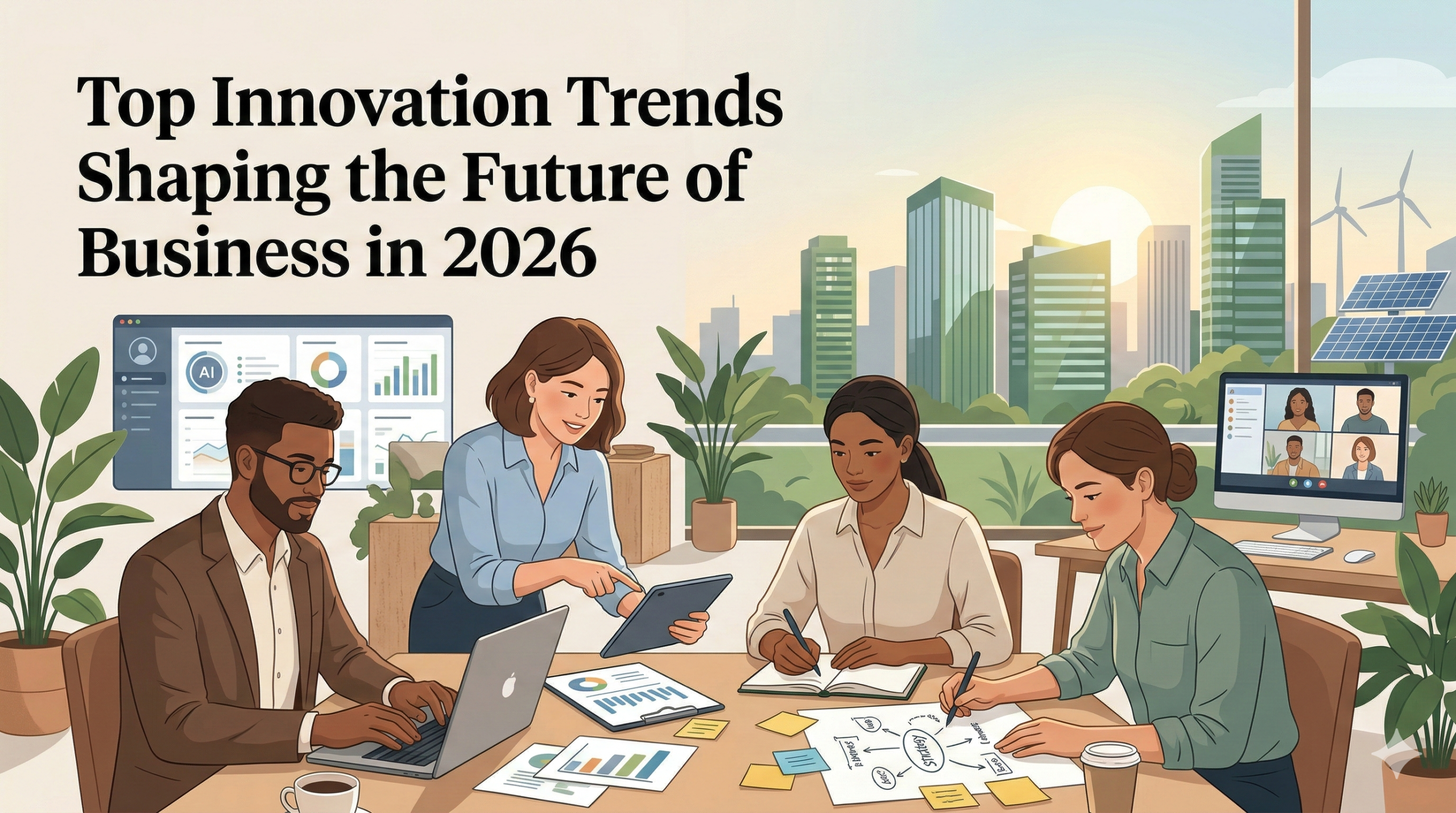
Innovation isn’t slowing down — it’s accelerating at a pace that’s rewriting the rules of business as we know them.
In 2026, companies aren’t just competing on products or price anymore; they’re competing on how fast they adapt, automate, and reinvent themselves. From AI-powered decision-making to sustainable tech breakthroughs and hyper-digital customer experiences, innovation has become the ultimate growth engine.
The businesses leading tomorrow aren’t waiting for change — they’re building it. In this article, we dive into the top innovation trends shaping the future of business in 2026, and why understanding them today could be the difference between leading your industry or struggling to keep up.
Innovation Trend #1 – Artificial Intelligence Becoming a Core Business Partner
Artificial Intelligence (AI) has moved far beyond simple automation. In 2026, AI functions as a strategic business partner rather than just a technical tool. Companies are using AI-powered analytics to forecast market trends, optimize pricing strategies, and improve decision-making in real time.
Customer service chatbots now deliver personalized support instantly, while marketing teams rely on AI to analyze consumer behavior and predict purchasing patterns. Supply chains are becoming smarter through predictive maintenance and demand forecasting, reducing delays and operational costs.
Businesses that successfully integrate AI into daily operations are gaining speed, accuracy, and efficiency — turning data into actionable insights that drive smarter growth.
Innovation Trend #2 – Hyperautomation and Smart Workflows
Hyperautomation is redefining productivity across industries. By combining artificial intelligence, robotic process automation (RPA), and cloud technologies, businesses are automating not only repetitive tasks but also complex workflows.
Routine operations such as invoice processing, employee onboarding, and data management can now run with minimal human intervention. This shift allows employees to focus on strategic thinking, creativity, and innovation rather than manual processes.
The result is faster execution, fewer operational errors, and significant cost savings. In a competitive marketplace, streamlined workflows give companies the agility needed to respond quickly to changing customer demands and market conditions.
Innovation Trend #3 – Sustainable and Green Innovation
Sustainability has evolved from a corporate responsibility initiative into a major innovation driver. Businesses in 2026 are investing heavily in green technologies, renewable energy solutions, and sustainable production methods.
Consumers increasingly favor brands that demonstrate environmental accountability, pushing organizations to adopt eco-friendly practices. Circular economy models — where products are reused, recycled, or repurposed — are gaining momentum across manufacturing and retail sectors.
Sustainable innovation not only reduces environmental impact but also strengthens brand reputation and long-term profitability. Companies that align innovation with sustainability are building trust while preparing for stricter global regulations and evolving consumer expectations.
Innovation Trend #4 – Digital Customer Experience Transformation
Customer expectations have reached an all-time high, and digital experience now defines brand loyalty. Businesses are leveraging advanced data analytics to deliver personalized interactions across websites, mobile apps, and social platforms.
Omnichannel strategies ensure seamless transitions between online and offline experiences, allowing customers to interact with brands anytime and anywhere. Emerging technologies such as augmented reality (AR) and immersive digital environments are transforming how customers explore products and services.
In 2026, innovation is customer-centric. Companies that prioritize convenience, personalization, and engagement are turning user experience into a powerful competitive advantage.
Innovation Trend #5 – Remote Collaboration and Future Work Technologies
The workplace has permanently evolved. Hybrid and remote work models are now standard, supported by advanced collaboration tools and cloud-based platforms. Innovation is enabling teams to work efficiently across locations, time zones, and cultures.
Virtual workspaces, AI-assisted project management tools, and real-time communication platforms allow organizations to access global talent without geographical limitations. This flexibility encourages creativity, faster problem-solving, and diverse perspectives.
Businesses that embrace future-of-work technologies are not only improving productivity but also attracting top talent seeking flexibility and modern work environments.
Innovation Trend #6 – Data-Driven Decision Making
Data has become one of the most valuable business assets. In 2026, successful organizations rely heavily on real-time analytics to guide strategic decisions. From customer insights to operational performance metrics, data empowers leaders to act with confidence rather than assumption.
Advanced analytics tools help companies identify opportunities, minimize risks, and optimize performance across departments. However, with increased data usage comes the need for stronger cybersecurity and governance frameworks.
Organizations that effectively harness data gain a measurable advantage, enabling faster responses to market shifts and more informed long-term planning.
Innovate or Fall Behind
The future of business belongs to organizations willing to evolve. Innovation in 2026 is no longer confined to technology departments — it shapes leadership, customer experience, sustainability, and workplace culture. Companies that embrace AI, automation, digital transformation, and data-driven strategies position themselves for lasting success.
As industries continue to change at unprecedented speed, innovation becomes more than a growth strategy; it becomes a survival mindset. Businesses that actively adapt, experiment, and innovate today will define the markets of tomorrow. The question is no longer whether innovation matters — but how quickly companies are ready to act.
-

 Featured1 year ago
20 Entrepreneurs to Watch Closeout 2024
-

 Innovation2 years ago
Leo Horacio: A Successful Entrepreneur in the Ecommerce and Online Sales Industry
-

 Innovation2 years ago
Innovators in Social-Emotional Learning: Dr. Myava Clark and Chris Clark Jr.
-

 Music2 years ago
Artist Deydee Signs $350,000 Contract with Rueda Empire LLC
-

 Latest2 years ago
Charles zhang recognized by forbes as #1 on michigan’s 2022 best in state wealth advisor list
-

 Uncategorized1 year ago
Trailblazer in Business: Alicia Fitts on Building Wealth and Community Through Faith
-

 Latest1 year ago
Florida Gov DeSantis signs 15-week abortion ban | Latest News
-

 Lifestyle2 years ago
Phillip Austin brings outlaw country to General Duffy’s stage – The Bulletin