
Featured
The Top Richest Women In The World 2022 – Forbes


A
mong the 2,668 billionaires on this year’s Forbes list, there are few women: just 327, down from 328 last year. In all, these 327 women (including those who share their fortune with their spouse, child or sibling) are worth a collective $1.56 trillion, up from $1.53 trillion last year.
The majority of these ultra-rich women—226— inherited their wealth, including the world’s three richest women: L’Oréal heiress Francoise Bettencourt Meyers, Walmart heiress Alice Walton and Julia Koch, who inherited a stake in Koch Industries when her husband, David Koch, died in 2019. This year’s richest new woman billionaire is also an heir: Czechia’s Renata Kellnerova and her four children inherited an estimated $16.6 billion after her husband, Petr Kellner, died in a helicopter crash in March 2021.
One hundred and one women on this year’s World’s Billionaires list are self-made–meaning they founded or cofounded a company or established their own fortune, as opposed to inheriting it–including roofing supply entrepreneur Diane Hendricks, Gap cofounder Doris Fisher and British online gambling entrepreneur Denise Coates.
Notable newcomers this year include Rihanna, whose beauty empire makes her Barbados’ first billionaire; Melanie Perkins, the 34-year-old cofounder of design startup Canva; and Melinda French Gates, who’s being listed as a billionaire in her own right following her divorce from Bill Gates in mid 2021.
The U.S. has the highest number of female billionaires in the world, with 90, followed by China (63, including 11 from Hong Kong) and Germany (35).
Net worths are as of March 11, 2022
Bettencourt Meyers is the richest woman on the planet for the second year running. She’s the granddaughter of the founder of beauty giant L’Oréal and first appeared on the World’s Billionaires List in 2018, following the death of her mother, Liliane Bettencourt, then the world’s wealthiest woman.
The daughter of Walmart founder Sam Walton, Alice Walton’s fortune is up by an estimated $3.5 billion over the past year thanks to rising Walmart stock. She was the world’s richest woman in 2020, but lost her spot to Bettencourt Meyers.3.
Julia Koch, the widow of conservative donor and philanthropist David Koch, and her children own a 42% stake in Koch Industries, the second-largest private company in the U.S. David’s older brother, Charles Koch, is chairman and also owns a 42% stake.
Since divorcing Amazon founder Jeff Bezos in 2019, Scott has become one of the most prolific philanthropists in history. She’s donated $12.5 billion to more than 1,250 organizations in less than two years.
Mars inherited an estimated one-third of Mars Incorporated, the candy and pet food conglomerate behind M&M’s and brands like IAMS and Pedigree. The company was founded by her grandfather, Frank C. Mars, in 1911.
Rinehart chairs Australian mining and agriculture company Hancock Prospecting Group, which was founded by her father Lang Hancock (d. 1992). For years, she has been embroiled in a court battle against her adult children over a family trust, which will continue until at least next year; a judge reportedly delayed their next court date to 2023.
The widow of Republican kingmaker and casino magnate Sheldon Adelson, Miriam now owns her late-husband’s nearly 50% stake in Las Vegas Sands following his death in early 2021. Two months after Adelson died, the company agreed to sell its marquee assets in Las Vegas, including the Venetian Resort and the Sands Expo and Convention Center, for $6.25 billion in an effort to focus on the Asia market.
Susanne Klatten owns about 19% of German automaker BMW, which she inherited from her mother Johanna Quandt and father Herbert Quandt, the industrialist who is credited with rescuing BMW from bankruptcy in 1959. Klatten also owns chemicals company Altana.
Fontbona is the widow of Chilean magnate Andrónico Luksic, who died of cancer in 2005 after building a fortune in mining and beverages. She and her family own copper mines in Chile through Antofagasta Plc, which trades on the London Stock Exchange. They also own a majority stake in Quiñenco, a publicly-traded Chilean conglomerate that does business in banking, beer and manufacturing.
Abigail Johnson has been CEO of Fidelity Investments since 2014 after taking over for her father Ned Johnson III, who died in March. She owns an estimated 24.5% stake in the firm, which has $4.2 trillion in managed assets and was founded by her grandfather in 1946.









Why Black Women Need to Speak Up About Bad Partnerships—and Why “I Want Out” Is Opening the Conversation
How many women have to get burned before we stop treating silence like loyalty?
A partnership can begin with excitement, shared goals, and promises of what you will build together. You bring your ideas, your relationships, your money, and your name. You believe that the person beside you wants to see you win.
Then something changes.
The promises become excuses. The responsibilities become uneven. Questions about money lead to arguments. Your contributions are overlooked, but your commitment is still expected.
And when you finally consider leaving, you face another question: What will people say?
For Black women navigating business, leadership, and community relationships, that question can carry weight. Will speaking up make you look difficult? Will people accuse you of tearing someone down? Will telling the truth cost you opportunities?
Those fears deserve an honest conversation. So does the price of keeping everything hidden.
The Partnership Can End. The Damage Can Follow.
A bad partnership can cost more than money.
It can affect your confidence, your reputation, and your willingness to trust yourself. You may find yourself questioning decisions you once felt certain about. You may hesitate to pursue another opportunity because the last one left you exhausted.
Sometimes the hardest part is admitting that something you worked so hard to build is hurting you.
You keep remembering the original vision. You hope one more conversation will fix the problem. You tell yourself that leaving would mean everything you invested was wasted.
But how much more must you lose before you give yourself permission to move forward?
You can believe in collaboration and still recognize when a particular partnership needs to end.
Black Women Deserve Room to Tell the Whole Story
There is room to celebrate Black women’s strength while also making space for their disappointment, anger, and pain.
We should be able to say, “This happened, and it hurt me,” without having to prove that we are strong enough to handle it alone.
We should be able to ask questions about a partnership without being labeled disloyal. We should be able to set boundaries without being called selfish. And we should be able to leave an unhealthy situation without carrying all the blame for its failure.
Supporting our community must include accountability within our community.
A shared background, a familiar face, or an impressive platform does not remove the need for honest communication and follow-through.
We deserve partnerships where respect is visible in the work, the decisions, and the way concerns are handled.
Your Experience Could Help Another Woman Recognize the Warning Signs
When women share what they have learned, others gain something they may desperately need: a clearer picture of what to watch for.
Someone may recognize the pattern of unanswered questions. Someone may realize she has been carrying responsibilities that were supposed to be shared. Someone may finally understand why she feels uncomfortable, even though everyone around her keeps calling the opportunity a blessing.
Speaking up can mean sharing the questions you wish you had asked, the boundaries you wish you had set, or the moment you realized you needed to leave.
It does not require sharing every private detail. A truthful account of your own experience can teach a powerful lesson.
And women who are not ready to speak publicly deserve support, too. The responsibility for harmful behavior belongs to the person who caused it. Sharing a story should be a choice made with care.
For the woman who is ready, her experience may become the warning she wishes someone had given her.
“I Want Out” Is Making Space for This Conversation
The forthcoming collaboration book “I Want Out” brings this conversation into the open.
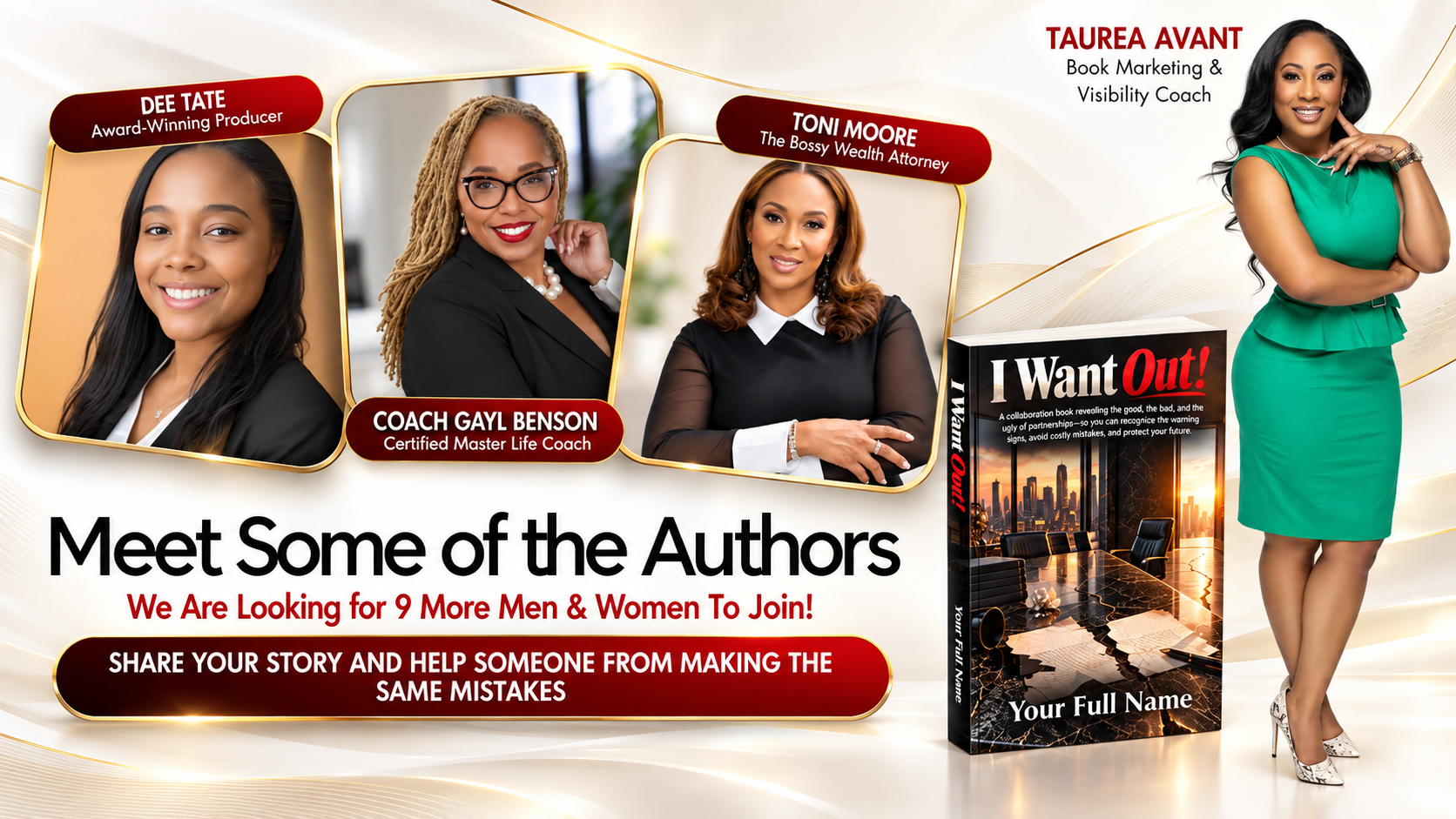
A collaboration book revealing the good, the bad, and the ugly of partnerships—so you can recognize the warning signs, avoid costly mistakes, and protect your future.
The project creates an opportunity for women and men to share experiences and lessons from partnerships—and to help others think more carefully about what they enter, what they accept, and when they choose to leave.
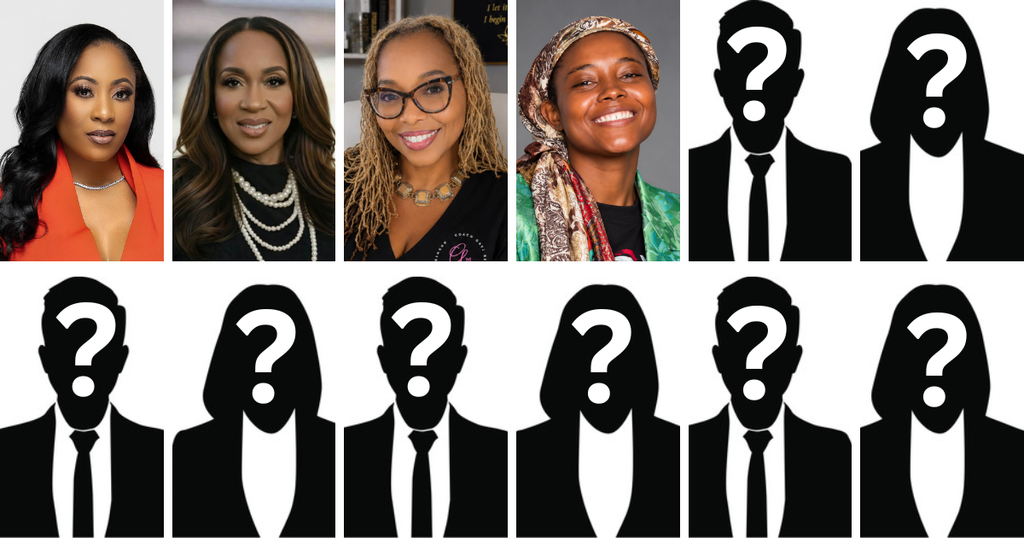
Among the women participating are Toni Moore, Dee Tate, and Coach Gayl Benson, whose professional backgrounds bring different perspectives to the conversation.
Toni Moore is an attorney and business strategist. Her website includes education for entrepreneurs on protecting their brands through trademark knowledge, adding a business protection perspective to the group.
Dee Tate is an award-winning film producer, multidisciplinary artist, poet, and author whose work explores faith, healing, identity, and becoming. She founded Chicago Production Assistants in 2016, growing a community of more than 7,000 members. Her work encourages people to recognize their lived experiences as a source of purpose, creativity, and impact.
Coach Gayl Benson is a Certified Master Life and Cognitive Behavior Coach who helps women challenge limiting beliefs and move toward their next chapter. Through her L.I.E.—Let It End—framework, she guides women in examining the stories they have accepted about themselves and recognizing their power to choose what comes next.
Their backgrounds reflect the range of voices this conversation needs: business knowledge, creative expression, and personal growth.
Meet the Woman Bringing “I Want Out” Together
“I Want Out” is being put together by Taurea “Vision” Avant, who is bringing contributors together to share honest stories and help others make more informed partnership decisions.
Taurea “Vision” Avant is a two-time TEDx speaker, author, and founder of Book Profits Club™. She helps authors, speakers, coaches, and entrepreneurs turn their books into tools for visibility, business growth, and income. Having spoken in more than 10 countries, Taurea brings an international perspective to helping people share their stories with purpose. Through publishing support, collaboration books, training, and media opportunities, she guides authors beyond writing toward building a platform. She also created Author Allstars™ Magazine to spotlight authors worldwide. Her mission is to help 1,000 authors earn more than $10,000 monthly by building businesses around their books.
We Are Looking for More Women and Men to Join Us
Have you experienced a partnership that left you saying, “I want out”?
Did you learn a difficult lesson about trust, boundaries, accountability, or walking away? Could sharing your experience help someone recognize the warning signs sooner or feel less alone?
We are inviting more women and men to become coauthors of “I Want Out.” While this article highlights Black women’s voices, the book welcomes both women and men who want to share honest experiences and valuable lessons about partnerships.
Your story does not have to end with everything perfectly resolved. What you have learned may give someone else the clarity or courage to make a better decision.
To learn about the book and becoming a coauthor, register for the information session at iwantout.collaborationbooks.com.
You cannot change what happened. But your voice may help someone else change what happens next.

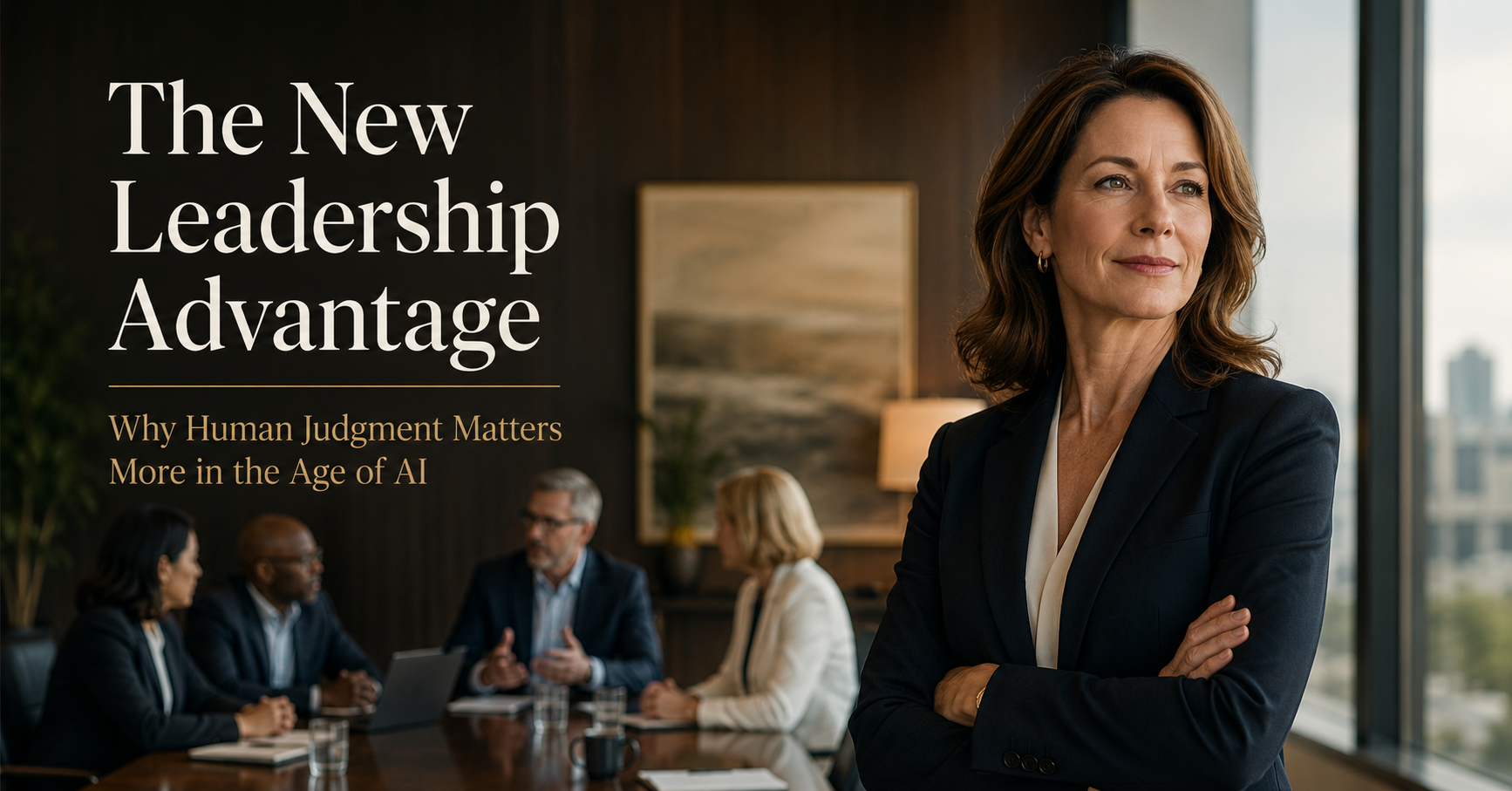
Artificial intelligence is changing more than the way companies work. It is changing what companies expect from their leaders.
For years, leadership was often associated with expertise. The person who knew the most, had the most experience, or could solve the hardest problem naturally moved into a position of authority.
In 2026, that model is being challenged.
AI can now analyze information, generate reports, summarize meetings, assist with strategy, write code, automate administrative work, and support increasingly complex business decisions. According to the World Economic Forum, roughly a third of workplace tasks are already automated, while organizations are placing greater value on distinctly human capabilities such as judgment, communication, empathy, and problem identification.
The strongest leaders of the next decade may therefore not be the people with all the answers.
They may be the people who know how to ask the right questions.
Leadership Is Moving From Expertise to Orchestration
AI does not eliminate the need for leaders. It changes their role.
A modern leader increasingly manages a combination of people, technology, automated systems, outside partners, and AI tools. Instead of personally controlling every decision, leaders must determine which decisions can be delegated, which require human judgment, and where technology needs stronger oversight.
This creates a new kind of leadership challenge.
Efficiency is relatively easy to measure. Trust is not.
An AI system may help a company finish a process faster, but employees still need someone who can explain why that process is changing, what the change means for their careers, and how they fit into the organization’s future.
That responsibility belongs to leadership.
Research highlighted by the World Economic Forum shows that 97% of HR leaders surveyed believe human-centered skills are more important in the AI era, while 64% say identifying new problems is becoming more valuable than simply solving existing ones.
That is an important distinction.
When technology becomes better at solving known problems, human advantage increasingly comes from recognizing opportunities and risks that technology has not yet been asked to examine.
Employees Need Direction, Not Just Technology
Companies around the world are investing heavily in AI, but buying technology is not the same as transforming an organization.
Employees are being asked to learn new systems while simultaneously wondering how automation could change their responsibilities.
This makes clarity one of the most valuable leadership skills in 2026.
People need to understand where the organization is going, why changes are happening, and what skills will help them remain valuable.
Recent workforce research points to skills gaps as one of the defining challenges facing organizations as AI adoption accelerates. Companies are increasingly focusing on reskilling, redesigning roles, improving internal mobility, and building more adaptable workforce structures.
Leaders who simply announce new technology may create uncertainty.
Leaders who connect technology with opportunity can create momentum.
The Best Leaders Will Build Future Leaders
There is another challenge developing quietly inside the AI economy.
Many entry-level tasks traditionally helped younger employees build judgment and experience. Preparing reports, performing basic analysis, handling administrative work, and solving smaller operational problems created opportunities to learn how businesses function.
AI is beginning to automate some of those tasks.
That creates efficiency today but could create a leadership-development problem tomorrow.
The World Economic Forum has warned that organizations need to rethink how younger workers gain the practical experience that traditionally prepared them for management.
Companies cannot assume leadership talent will develop automatically.
Managers will need to deliberately give employees opportunities to make decisions, evaluate AI-generated work, communicate with customers, manage uncertainty, and take responsibility for outcomes.
In other words, organizations must automate tasks without accidentally automating away the experiences that develop good leaders.
Trust Will Become a Competitive Advantage
Technology moves quickly. Human confidence usually moves more slowly.
That gap matters.
Organizations with strong leadership cultures will be able to introduce new technologies without creating unnecessary fear or confusion. Employees are more likely to experiment, learn, and adapt when leaders communicate openly about both opportunities and risks.
This does not mean leaders need to have complete certainty.
In fact, modern leadership increasingly requires being comfortable saying, “We don’t know yet, but here is how we are going to find out.”
That type of transparency can be more powerful than pretending to have perfect answers in an environment that changes every month.
The Leader of the Future Is an Enabler
The AI era is not reducing the importance of leadership.
It is exposing the difference between authority and leadership.
Authority can tell people what to do.
Leadership helps people understand where they are going.
As technology becomes more capable, the qualities that make human leaders valuable become clearer: judgment, curiosity, courage, empathy, communication, accountability, and the ability to create direction when certainty is unavailable.
The organizations that succeed will not simply have the most advanced AI.
They will have leaders who know how to combine advanced technology with capable, confident people.
That may become the defining leadership advantage of the AI age.
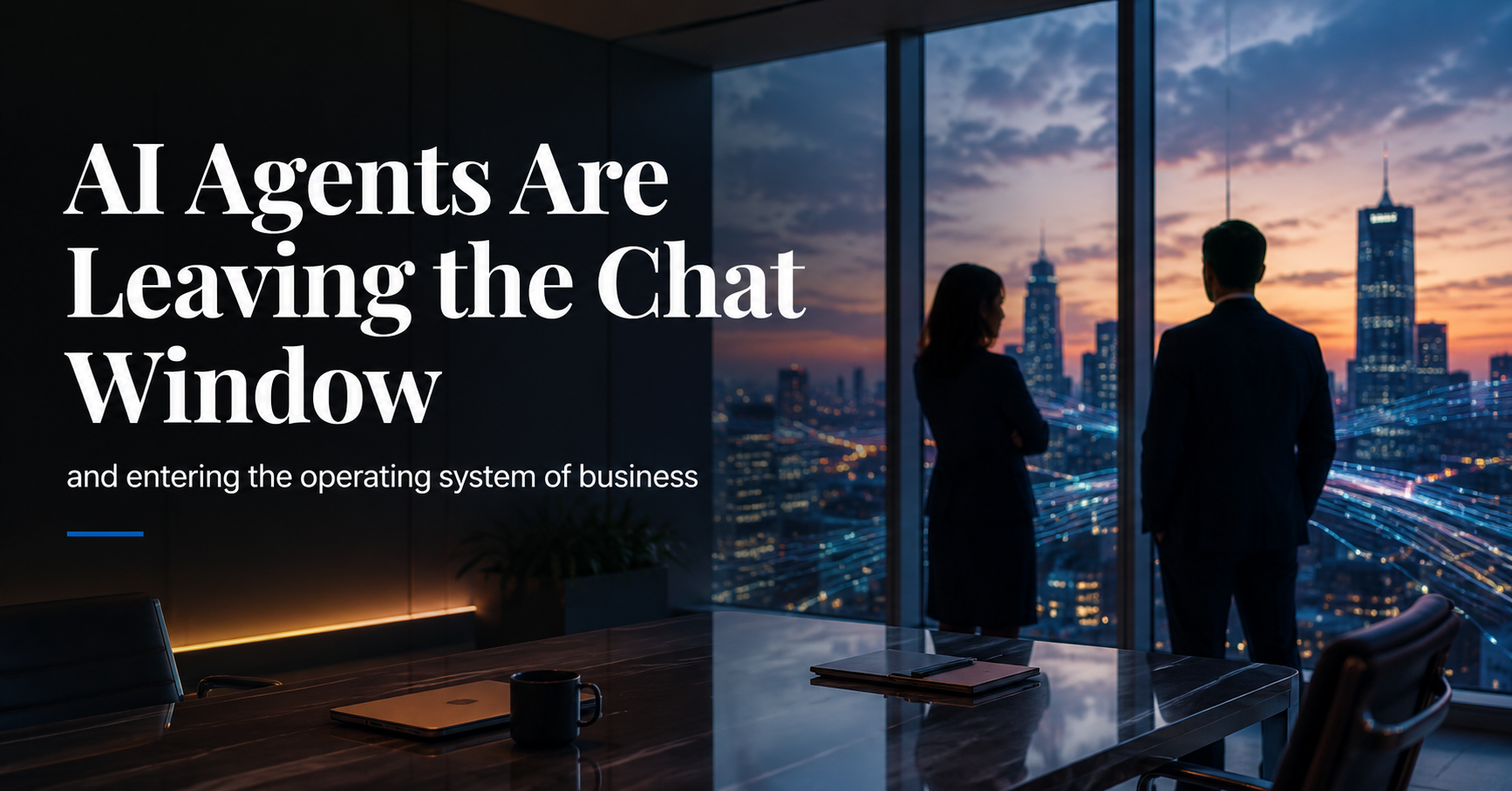
The next phase of artificial intelligence is not about getting better answers. It is about software that can take action, complete workflows and increasingly operate alongside human teams.
For the past several years, artificial intelligence has largely been experienced through a chat box. A user asks a question, the system generates an answer, and a person decides what happens next.
In 2026, that model is beginning to change.
The technology industry is moving rapidly toward AI agents—systems designed not merely to provide information but to perform tasks, interact with software, make decisions within defined limits and complete multi-step workflows.
Gartner has projected that as many as 40% of enterprise applications could include task-specific AI agents by the end of 2026, compared with less than 5% in 2025. That represents a fundamental shift in how businesses may interact with software.
From Answers to Actions
The difference between an AI assistant and an AI agent may sound technical, but its business implications are straightforward.
An assistant might draft an email telling a customer that an appointment is available.
An agent could potentially check the calendar, schedule the appointment, update the customer record, send the confirmation and trigger the appropriate follow-up.
That difference—between recommending an action and executing an action—is becoming one of the most important developments in enterprise technology.
Meta, for example, introduced a Business Agent in June 2026 designed to handle activities such as answering customer questions, qualifying leads, booking appointments and potentially processing transactions. The company said more than one million businesses were already using earlier versions of its business chatbots across WhatsApp and Messenger.
Similar competition across the technology industry suggests that agentic AI is becoming less of a laboratory experiment and more of a commercial product category.
Small Businesses Could Be Major Beneficiaries
Large corporations have obvious reasons to invest in automation, but AI agents could have an even more noticeable impact on smaller companies.
A large enterprise can employ separate teams for customer support, marketing, administration, research and operations. A small company often expects the same person—or the founder—to handle several of those responsibilities.
AI could begin narrowing that operational gap.
The OECD’s 2026 D4SME survey, which examined more than 2,000 small and medium-sized businesses across 12 OECD countries, found that SME adoption of AI is rising rapidly. Most currently rely on off-the-shelf tools, while some have started experimenting with more customized applications and AI agents.
That creates the possibility of a new kind of small company: one where a relatively small human workforce coordinates a much larger digital operating layer.
A five-person business may still have five employees, but those employees could eventually have AI systems handling research, scheduling, routine customer questions, document preparation, data entry and portions of sales administration.
The Real Challenge Is Trust
The excitement surrounding AI agents also introduces a much harder question.
How much authority should software receive?
Allowing an AI system to draft a response is relatively low risk. Allowing it to issue refunds, change customer records, approve purchases or communicate independently with clients requires far stronger controls.
Meta itself has acknowledged the risks that emerge when AI agents are connected deeply to business systems and given permission to act.
The companies that succeed with agentic AI therefore may not be those that automate the largest number of tasks first. They may be those that build the clearest boundaries around what machines can do independently, what requires approval and what must remain entirely human-controlled.
Security, data governance, audit trails and human oversight are becoming just as important as model intelligence.
The OECD has similarly found that although AI adoption among SMEs is growing, secure and strategic integration remains uneven, with skills shortages, implementation costs and limited time among the barriers facing smaller firms.
The Competitive Advantage Will Come From Redesigning Work
There is another reason the AI-agent shift matters.
Simply inserting an AI tool into an old process may produce incremental efficiency. Redesigning the process around what humans and machines each do best could produce something much larger.
Imagine a sales team where an AI system continuously organizes leads, researches prospects and prepares account summaries while humans focus on relationship building and negotiation.
Or a logistics company where agents watch inventory, flag unusual movements, prepare recommendations and coordinate routine actions while managers concentrate on exceptions and strategic decisions.
The technology becomes more valuable when businesses stop asking, “Which employee task can AI copy?” and start asking, “How would we design this operation if intelligent software had always existed?”
2026 May Be Remembered as the Transition Year
Generative AI first attracted mass attention because machines could produce surprisingly human-like text and images.
The next stage may attract attention for a different reason: machines will increasingly be judged by what they accomplish, not simply by what they generate.
Gartner expects the evolution to continue beyond individual task agents toward groups of specialized agents collaborating across applications and business functions.
That future is not guaranteed to arrive smoothly. Technical failures, cybersecurity threats, regulatory questions and organizational resistance will continue to shape adoption.
But the direction is becoming clearer.
The defining question of the AI era is changing from “What can AI tell me?” to “What can AI responsibly do for me?”
For businesses, entrepreneurs and technology leaders, that may prove to be the far more consequential question.
-

 Featured2 years ago
20 Entrepreneurs to Watch Closeout 2024
-

 Real Estate2 years ago
Startups Are Looking To Fractionalize Real Estate Assets, But Should They? – Forbes
-

 Innovation2 years ago
Leo Horacio: A Successful Entrepreneur in the Ecommerce and Online Sales Industry
-

 Innovation2 years ago
Innovators in Social-Emotional Learning: Dr. Myava Clark and Chris Clark Jr.
-

 Music2 years ago
Artist Deydee Signs $350,000 Contract with Rueda Empire LLC
-
 Latest2 years ago
Florida Gov DeSantis signs 15-week abortion ban | Latest News
-
 Uncategorized2 years ago
Trailblazer in Business: Alicia Fitts on Building Wealth and Community Through Faith
-

 Latest2 years ago
Charles zhang recognized by forbes as #1 on michigan’s 2022 best in state wealth advisor list